Chilat Doina
March 21, 2026
At its core, reselling on Amazon is simple: you buy products from one place—whether it's a retail store, a wholesaler, or even a liquidation auction—and then sell them on Amazon for more than you paid. It's a fantastic way to jump into e-commerce by tapping into Amazon's colossal customer base without the headache of building a brand from the ground up. The real game is finding those in-demand products with enough profit margin to make it all worthwhile.
If you're ready to get serious and build a real, scalable business on Amazon, you're in the right place. We're going to skip the fluff and dive straight into the strategies that separate the seven-figure sellers from the casual hobbyists.
This is about more than just listing a few items and hoping for the best. It's about building a well-oiled reselling machine. To do that, you first need a solid plan. We’ll walk through the main business models and get into the nitty-gritty of each, helping you pick the one that actually fits your budget and your long-term goals.
So, what's actually possible here? The numbers are pretty compelling. In 2024, the average Marketplace seller—many of whom are straight-up resellers—pulled in $290,000 in annual sales. That's a 16% jump from the year before, which tells you the opportunity on Amazon is still growing fast. This isn't just a fluke; it's part of a huge trend where third-party sellers are driving a massive slice of Amazon's sales. You can dig into even more seller data over at analyzer.tools.
Of course, you're not alone. The U.S. market has about 1.1 million active sellers, all competing for the attention of over 3.1 billion monthly visitors. Don't let those numbers scare you. It just means that while the competition is real, the customer base is absolutely enormous for sellers who know what they're doing.
The big picture is this: reselling isn't saturated, it’s just competitive. Success comes from a smart, systematic approach to finding and selling products, not from getting lucky. You need to build a system that churns out profitable inventory like clockwork.
The first real decision you have to make is which business model to follow. Each one has its own pros, cons, startup costs, and potential for growth.
To give you a quick overview, here’s a breakdown of the most common paths you can take.
This table should help you match your own goals and resources with the right strategy.
| Model | Sourcing Method | Startup Cost | Scalability | Best For |
|---|---|---|---|---|
| Arbitrage (OA/RA) | Buying from other retail stores (online or in-person) | Low ($500+) | Moderate | Beginners, testing the waters, low-risk entry. |
| Wholesale | Buying in bulk from brands or distributors | Medium ($2,000+) | High | Sellers ready for stable, long-term growth. |
| Liquidation | Buying overstock or closeout inventory | Varies (Low to High) | Low to Medium | Treasure hunters who can handle inconsistent supply. |
Let's unpack what these really mean for you.
Online & Retail Arbitrage (OA/RA): This is the classic starting point. You're essentially a deal hunter, buying discounted products from stores like Walmart, Target, or their online counterparts and flipping them on Amazon. It's the fastest way to get your feet wet with a relatively small amount of cash.
Wholesale: This is where you graduate to buying products in bulk, directly from the brand or an authorized distributor. You get much better pricing and a more consistent supply of inventory, but it takes more capital to get started and requires building real relationships with suppliers.
Liquidation: This involves buying pallets or truckloads of inventory from businesses that are closing up shop or getting rid of overstock. The deals can be incredible, but the supply is unpredictable, and you often have to sort through a mixed bag of products in varying conditions.
Think of it like choosing your vehicle for this journey. Arbitrage is like a nimble scooter—perfect for zipping around town, learning the streets, and making quick cash. Wholesale is your reliable delivery truck, built to haul serious volume and go the distance. Your choice here sets the stage for your entire strategy and how you'll eventually scale.
It’s easy to get caught up in the excitement of jumping into the Amazon marketplace. And why not? It's a massive opportunity. As of early 2025, there are over 9.7 million sellers registered, but the fascinating part is that only about 2.5 million are actively selling.
That gap tells a story. It's the difference between those who treat this like a business from day one and those who don't.
Before you even dream of sourcing your first product, you have to do the unglamorous work of laying a solid foundation. This is what separates a scalable asset from a stressful hobby that eventually fizzles out. Get this part right, and you'll save yourself from some major headaches down the road.
Your first big decision is how you'll legally structure your operation. This choice impacts your taxes, but more importantly, it defines your personal liability. For most new sellers, it comes down to two paths.
Sole Proprietorship: This is the default setting. If you just start selling under your own name, congratulations, you're a sole proprietor. It's dead simple and requires zero paperwork. The huge downside? There's absolutely no separation between you and the business. If something goes wrong and your business gets sued, your personal assets—your car, your house—are on the line.
Limited Liability Company (LLC): This is the move for anyone serious about building a real business. An LLC creates a separate legal entity, effectively building a firewall between your business and your personal life. If the business has debts or faces a lawsuit, your personal assets are shielded. It takes a bit of paperwork and a small filing fee, but the peace of mind is priceless.
For anyone with plans to scale, forming an LLC isn't just a good idea; it's a must.
Once your business entity is sorted, it's time to set up your home base: your Amazon Seller Central account. Here you’ll hit another fork in the road—the Individual vs. the Professional selling plan.
Don't get hung up on the names. "Individual" isn't just for hobbyists, and "Professional" isn't reserved for massive corporations. This is purely a numbers game.
The math is incredibly simple.
The Individual plan dings you $0.99 for every item you sell. The Professional plan is a flat $39.99 per month, no matter your sales volume. A quick calculation shows the breakeven point is exactly 40 sales per month.
If you have any confidence you'll sell more than 40 units in a month, the Professional plan is a no-brainer. Plus, it unlocks the features you absolutely need to compete, like being eligible for the Buy Box, getting access to better sales reports, and using third-party software like repricers.
This is where so many new sellers trip up, but getting your compliance in order is what makes your business legitimate and sustainable.
First on the list is a Sales Tax Permit, which might also be called a seller's permit or resale certificate. You'll get this from your state's tax authority. This little piece of paper allows you to legally collect sales tax from customers in your state. Just as important, it lets you buy inventory for resale without paying sales tax on it yourself, which is a huge advantage.
You'll also need to check with your local city and county about a Business License. A quick search on your local government's website will tell you exactly what you need. Taking these steps from the get-go professionalizes your operation and builds a business that’s ready to grow without any legal skeletons in the closet.
The whole engine of a successful Amazon reselling business runs on one thing: profitable products. It sounds simple, but finding those products consistently is what separates the pros from the people just trying it out. Forget the generic "buy low, sell high" talk. Let's get into the specific, repeatable sourcing methods that top sellers actually use to build their inventory.
This is where the real work happens, and it’s where the money is made. Think of it as a treasure hunt that demands strategy, the right tools, and a bit of hustle. Your main hunting grounds will be retail stores, online shops, and wholesale suppliers.
Arbitrage is just a fancy word for spotting a price difference between two places. For us, it means finding a product at a store (online or physical) for way cheaper than it’s selling on Amazon.
Retail Arbitrage (RA): This is the classic, get-your-hands-dirty approach. You're physically walking into stores like Walmart, Target, Home Depot, or even local discount shops. Armed with a scanner app on your phone, you hunt for clearance items and look for big price gaps. It’s an active way to learn the business and can generate cash flow fast. You might find a popular board game on clearance for $10 that you know sells on Amazon for $40. That’s a win.
Online Arbitrage (OA): This is just RA, but from your couch. Instead of driving around, you’re digging through websites for the same kinds of deals. You might be stacking sale prices and coupon codes on Kohls.com or finding a hidden gem on a niche retail site. The products get shipped to your house (or a prep center), and then you send them off to Amazon.
Both RA and OA demand a good eye for a deal and a firm grasp on how to calculate your real profit after Amazon takes its cut.
Going sourcing without data is a quick way to lose money. Guesswork will fill your garage with products that just sit there. Your smartphone, loaded with the right app, is your single most important tool.
The Amazon Seller App is the free starting point. It's the bare minimum. You can scan a barcode to see if you're even allowed to sell the product, check the current price, and get a rough idea of your fees.
But serious resellers almost immediately upgrade to a paid, third-party scanner app like Scoutify 2 or Scan Power. These tools give you much richer data right on the spot, including:
A product might look profitable today, but a quick check of its Keepa chart might reveal that the price is historically much lower and is likely to drop again. This historical data prevents you from buying based on a temporary price spike.
Arbitrage is a fantastic way to start, but it can be tough to scale. You're always on the hunt for that next one-off deal. For a more stable and scalable business, wholesale sourcing is the next logical step.
Here, instead of buying single items from a retailer, you open an account directly with a distributor or the brand itself. This lets you buy products by the case at true wholesale pricing. The best part? You can often reorder the same profitable items over and over again.
The first hurdle is finding these suppliers. This takes research, networking, and some cold outreach. You're looking for authorized distributors for the brands you want to carry. A great tip is to just look at the product's packaging—sometimes the distributor’s info is printed right on the box.
Once you find a potential supplier, you'll need to open an account, which usually means providing your business info and a copy of your resale certificate. As you build a relationship, place consistent orders, and pay your bills on time, you can get access to better pricing and even exclusive deals. This creates a reliable backbone for your entire Amazon business. You can also explore our detailed guide on the best Amazon product research tools to uncover more opportunities.
So you’ve found a profitable product to sell. That's a huge first step, but the real fight for your money happens on the product listing itself. The grand prize? That little piece of digital real estate called the Buy Box.
Winning the Buy Box is everything. It’s the "Add to Cart" button that gets the overwhelming majority of sales. When you and other resellers are on the same listing, Amazon’s algorithm gets to decide who gets that prime spot. And it's not just a race to the bottom on price.
The algorithm is trying to figure out which seller offers the best possible experience for the customer. If you want to scale your sales, you absolutely have to master the variables it cares about.
While nobody outside of Amazon knows the exact formula, experienced sellers have a very good idea of what matters. Think of it like a scorecard. To win, you need to have the highest score across a few key areas, making you the most attractive choice in the algorithm's eyes.
Here are the most influential factors:
This all starts, of course, with finding something worth selling in the first place.
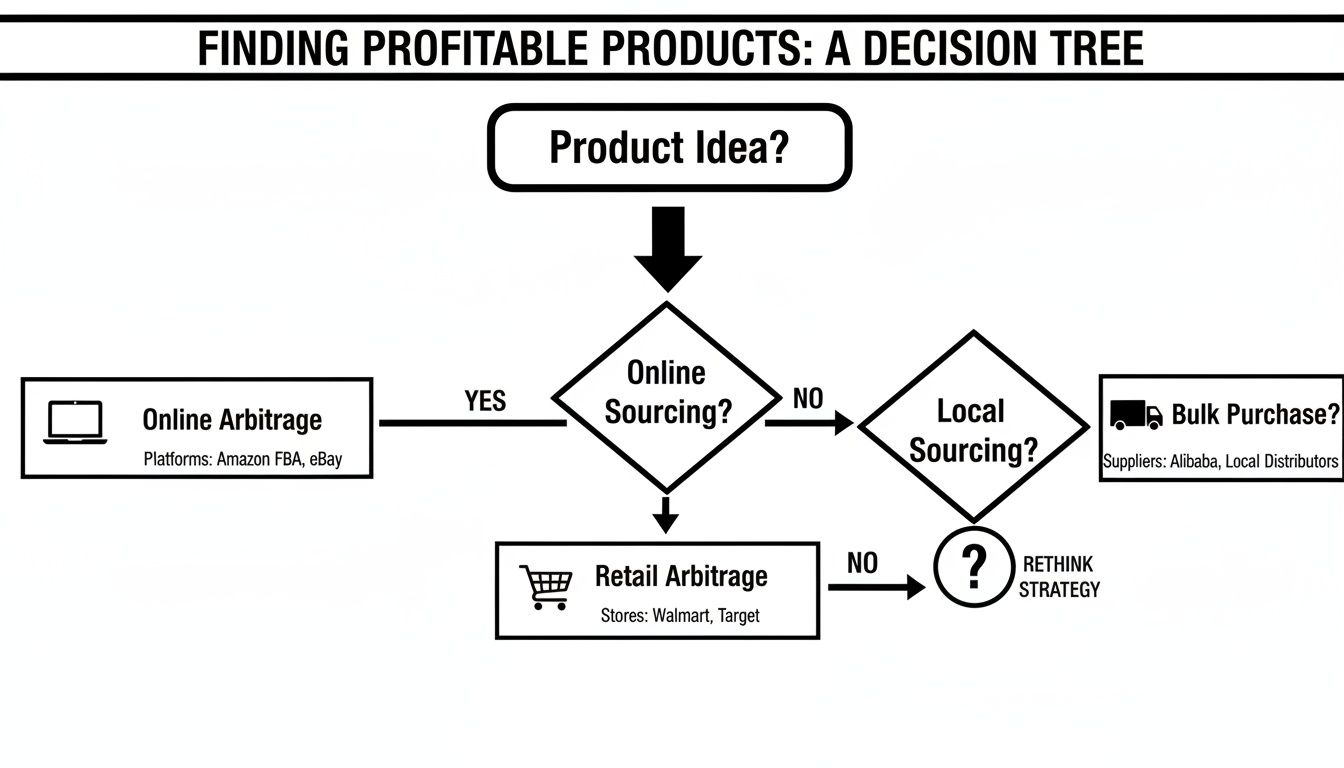
Whether you’re doing arbitrage or wholesale, the goal is to get inventory you can flip for a profit. Once you have that, your entire focus shifts to winning the sale on the listing.
Trying to manually adjust your prices 24/7 to stay competitive is a losing game. It's just not possible. This is where automated repricing software becomes one of the most important tools in your arsenal.
But be careful. Using a repricer without a smart strategy is a fast way to destroy your profit margins in a pointless race to the bottom. The secret is setting strategic rules.
A good repricing strategy isn't just about undercutting the next seller. You can get much more specific.
For example, you can program your repricer to:
A common mistake is thinking the lowest price always wins. A better approach is to price for the Buy Box, not just to be the cheapest. Often, you can win the Buy Box at a price that is 1-3% higher than the lowest offer if you have a superior fulfillment method (FBA) and stronger seller metrics.
Most of the time, you'll be "piggybacking" on product pages that already exist. But what happens when you find a listing that's just plain awful? A page with terrible photos, a weak title, and wrong information is going to have terrible sales, no matter how good your price is.
This is your chance to add value by creating a brand-new listing for a bundle or a multipack.
Let's say you're selling a popular brand of shampoo. Instead of jumping on the single-bottle listing with 30 other sellers, you could create a new listing for a "Pack of 3." This generates a totally new ASIN where, at least for a while, you're the only seller.
You get to control the photos, the title, and the bullet points, and you have zero direct competition for the Buy Box. It's an advanced technique, but it lets you build a small moat around your profitable inventory.
Winning this part of the reselling game comes down to a deep understanding of what drives sales on Amazon. You can learn more by exploring our detailed guide on what the Amazon Buy Box is and how it works. By combining a competitive price, the power of FBA, and perfect seller metrics, you can start capturing the sales you need to grow your business.
When you're first starting, you can get away with doing everything by hand. But the manual process that got you your first 50 sales will absolutely bury you when you're trying to hit 5,000. To really grow, you have to stop touching every single item and start building systems.
The absolute foundation of any scalable reselling business is Fulfillment by Amazon (FBA). You send your inventory to Amazon’s fulfillment centers, and they take over the entire grind: picking, packing, shipping, and even handling customer service and returns. This one decision is what lets a solo entrepreneur go toe-to-toe with major retailers.
The most immediate perk of FBA is that beautiful little Prime badge on your listings. It’s a massive signal of trust and fast shipping that immediately bumps up your conversion rates. More importantly, it gives you a huge leg up in winning the Buy Box, which is the key to consistent, high-volume sales.
But FBA isn't a "set it and forget it" deal. You have to manage it actively. Amazon watches you like a hawk and gives you an Inventory Performance Index (IPI) score based on how well you manage your stock. If that score drops too low, they can slap you with storage limits, which completely chokes your ability to send in more products.
To keep your IPI score healthy, you need to obsess over a few key metrics:
This is a critical fork in the road for many sellers. For a much deeper breakdown of the pros and cons, this guide on Amazon FBA vs FBM is a must-read.
While FBA handles the physical work, you need software to automate the mental work. Manually repricing and tracking profits on spreadsheets just won't cut it once you have hundreds or thousands of SKUs.
Your "tech stack" is the collection of software that runs your business for you, freeing you up to focus on the one thing that actually grows the business: sourcing more profitable products. This is how you finally make the leap from working in your business to working on it.
A solid tech stack for a growing reseller usually includes:
Key Takeaway: Scaling isn't about working harder; it's about building systems that work for you. FBA is your physical labor system, and your tech stack is your digital brain. You need to invest in both to see real growth. If you're ready for a deep dive, you can learn more about what is FBA and all its nuances.
Once you decide to get serious about reselling on Amazon, the same big questions always pop up. How much cash do I really need? What could actually sink my business? Should I go all-in on FBA?
Let's cut through the noise. Here are the straight answers you'd get from a seasoned seller, based on what actually works—and what doesn't—in the real world.
You’ll hear stories of people starting with a few hundred bucks and a dream. While that's technically possible with some retail arbitrage luck, it's not a sustainable business plan.
If you’re serious about building something that can actually grow, you need a real inventory budget. A realistic starting point is somewhere between $3,000 and $5,000.
This isn't just a random number. That amount of capital gives you the runway to:
And remember, that's just for inventory. You have to factor in your operational costs separately.
Don't forget to budget for the tools of the trade. We're talking about your Professional Seller Account fee ($39.99/month), essential software like scanner apps or repricers ($50-$200+/month), and any business setup costs.
Every business has its landmines, and Amazon is no exception. The three that will knock you out of the game fastest are account suspension, IP complaints, and just plain bad cash flow management.
Staying in business long-term means getting ahead of these.
For account suspension, you have to be obsessive about your account health. Keep your Order Defect Rate (ODR) under 1% and treat every single performance notification from Amazon like it's a fire alarm.
When it comes to brand restrictions and IP complaints, you have to do your homework before you buy. Use the Amazon Seller App on the spot to check if you're even allowed to sell an item. Tools like IP-Alert are also a lifesaver for flagging brands known to cause trouble for resellers.
Finally, poor cash flow is the silent killer. You have to know your numbers, down to the penny. Track your true ROI after Amazon’s fees, your shipping costs, and software subscriptions. A classic rookie mistake is going all-in on a big pile of unproven inventory. The smart play is to test small, find a winner, and only then go deep.
For about 95% of resellers who want to build a scalable business, this isn't even a debate: it's FBA (Fulfillment by Amazon). The power of the Prime badge is undeniable.
Using FBA is the fastest way to win the Buy Box and drive sales. More importantly, it takes the entire logistical nightmare of picking, packing, shipping, and customer service off your plate. This frees you up to do the one thing that actually makes you money: sourcing more profitable products.
That said, FBM (Fulfillment by Merchant) isn't useless. It has its moments.
A hybrid model can work wonders for experienced sellers, but if you're just starting out or focused on growth, mastering FBA is your most direct path forward.
The strategies discussed here are just the beginning. The most successful entrepreneurs know that growth accelerates when you surround yourself with a network of peers operating at the same high level. Million Dollar Sellers is an exclusive, invite-only community where top 7-, 8-, and 9-figure e-commerce founders share the exact strategies they use to stay ahead. If you're serious about scaling your business and connecting with the best in the industry, learn more about joining the MDS community.
Join the Ecom Entrepreneur Community for Vetted 7-9 Figure Ecommerce Founders
Learn MoreYou may also like:
Learn more about our special events!
Check Events