Chilat Doina
May 12, 2026
TikTok Shop stopped being an experimental channel the moment it hit $33 billion in GMV in 2024 according to RNO1's breakdown of TikTok Shop agency partner growth. That number changes the conversation for serious operators.
At 7, 8, and 9 figures, the question isn't whether TikTok Shop matters. The question is whether you'll build a system that turns creator traffic, affiliate distribution, and shop operations into profitable revenue, or whether you'll burn budget chasing clips, creators, and coupons with no durable model behind them.
A good tiktok shop agency partner doesn't just “run TikTok.” They own the ugly middle. Creator outreach, offer design, attribution, shop health, stock coordination, content velocity, and performance reviews. A bad one does the opposite. They flood your Slack with vanity screenshots while your margins erode, your catalog gets pushed to the wrong creators, and your team confuses motion with progress.
Founders who win on TikTok Shop usually treat agency selection like capital allocation. That's the right frame. You're not hiring for vibes. You're underwriting a distribution engine.
TikTok Shop did $33 billion in GMV in 2024. For a 7 to 9 figure brand, that makes the channel too large to treat like a side test, but size alone is not the reason to hire help. The reason is execution risk.
TikTok Shop is a live operating system. Creative output, affiliate recruitment, promo strategy, inventory availability, fulfillment speed, shop health, and attribution all affect the same P&L. If one layer slips, paid efficiency drops, creators lose momentum, conversion rates soften, and margin disappears faster than most finance teams expect.

Internal ecommerce teams usually understand brand standards, retail calendars, and contribution margin. What they often lack is TikTok-native operating speed. The channel rewards fast creator seeding, daily content judgment, aggressive affiliate management, and constant SKU-level decision making. A team built for Meta, email, and Amazon often cannot absorb that workload without something else breaking.
That gap shows up in financial terms, not just workflow pain. Creator samples go out late. Winning clips do not get whitelisted or reposted fast enough. Discounting gets approved without a margin guardrail. Inventory gets pushed into demand spikes the supply chain cannot support. Revenue may still show up, but blended CAC, return rates, and net contribution tell a less flattering story.
A strong tiktok shop agency partner closes those gaps with process and specialization. The right one should improve forecast accuracy, shorten content-to-launch cycles, and give operators a tighter grip on unit economics.
Founders should treat this decision the same way they would treat any search for an experienced business growth partner. The question is simple. Can this team produce profitable throughput on a channel that changes every week?
The primary value is gaining control, not just convenience. Good partners build reporting that ties creator output to orders, refunds, affiliate payouts, ad spend, and contribution margin by SKU. They create operating cadence around what matters. Revenue concentration by creator, live conversion rate, shipped-on-time performance, sample-to-activation rate, and the payback period on promotional spend.
That changes how a founder manages the channel. Instead of asking whether TikTok content is “working,” you can ask whether creator cohort A is outperforming cohort B after fees, whether hero SKUs can absorb stronger affiliate commissions, and whether live selling deserves more inventory allocation next month.
Use the same rigor you would apply to any agency search. Strong Miami agency vetting criteria for business growth matters here because polished reporting can hide weak economics for longer than it should.
A weak partner adds activity. A strong partner adds financial control, operating discipline, and scale that holds up under pressure. That is the difference between participating in TikTok Shop and building a channel that can become material to enterprise value.
Founders rarely lose money on TikTok Shop because they picked the wrong deck. They lose it because they picked the wrong operator, then gave that operator enough time and budget to hide weak economics.
This hiring process should look closer to M&A diligence than agency shopping. The job is to find a partner who can turn creator output, offers, and inventory into profitable volume without blowing up contribution margin, service levels, or brand control.
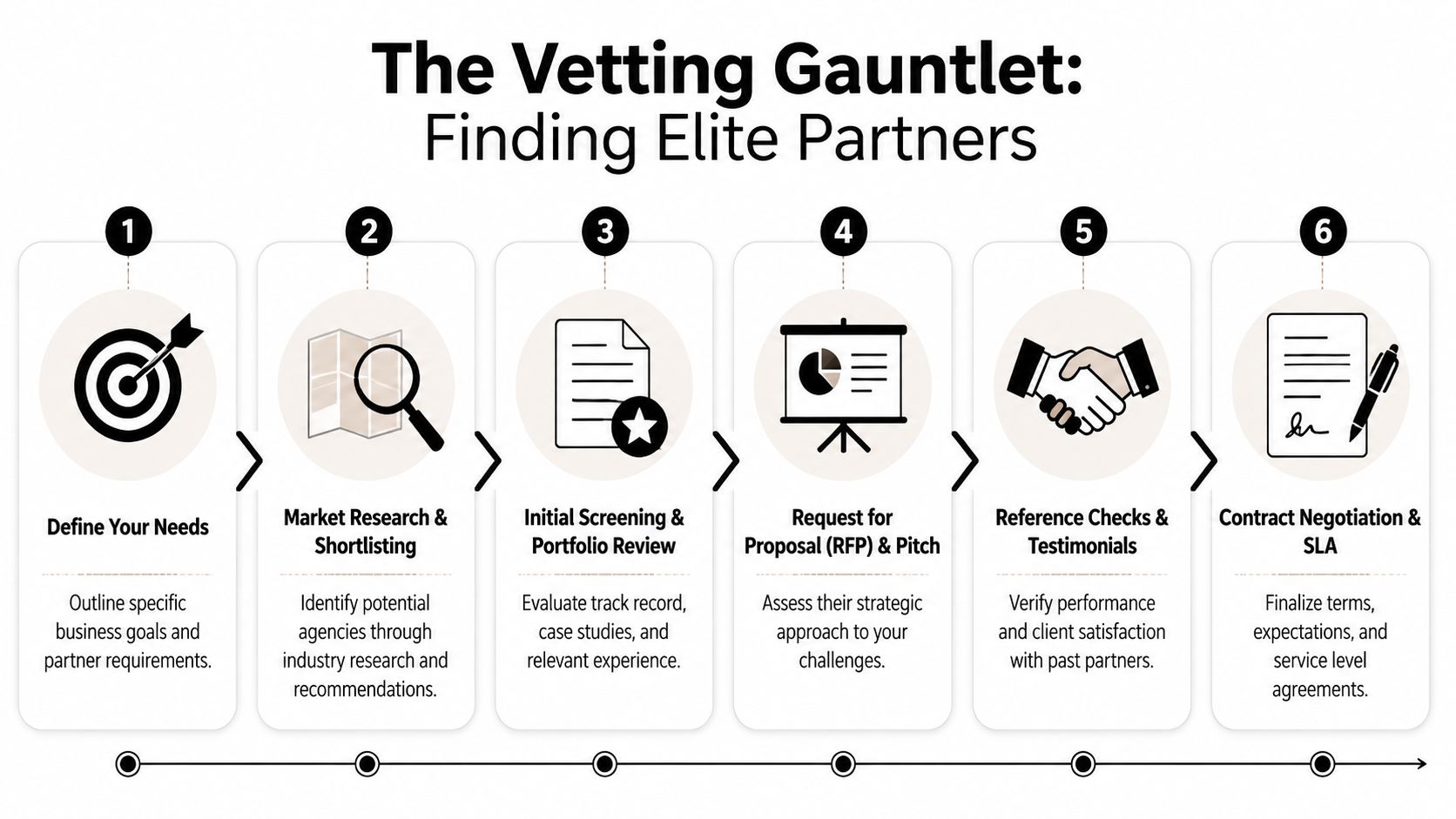
Use three sourcing lanes.
Start with TikTok's own partner ecosystem and seller resources. That does not prove commercial strength, but it does screen for teams that at least understand the platform's rules, tooling, and operating cadence.
Next, ask founders in adjacent brands. The useful referrals come from operators with similar AOV, margin structure, return profile, and fulfillment constraints. A supplement brand, a beauty brand, and a bulky home brand can all grow on TikTok Shop, but the creator mix, promotion strategy, and operational tolerance are completely different.
Then pressure-test how the agency thinks. A framework like these Miami agency vetting criteria for business growth helps because it forces a review of accountability, communication, commercial fit, and execution discipline instead of surface polish.
If you want a broader operator lens, apply the same logic you would use when evaluating the right business partner for growth. Agency misalignment is still partnership risk. It just shows up faster in your P&L.
Do the filtering before anyone gets on Zoom. Ask for material that shows how they run the channel.
Resistance here is useful. It tells you how they behave when a client asks for transparency.
Big creator rosters sound good in a pitch. What matters is how many creators in that roster have produced efficient sales in your category.
Ask for active creator counts by niche, recent activation rates, average time from sample sent to first post, and the percentage of creators who produced more than one order-driving asset. Follower count matters far less than sell-through, content quality, and payout efficiency.
A serious operator can walk from product selection to creator brief to offer structure to net result. Ask for the unit economics.
You want to see gross sales, affiliate commissions, product cost, freight, platform fees, refunds, sampling cost, ad support if used, and resulting contribution margin. If they can only show GMV, views, and top-line growth, they are hiding the part that determines whether scale helps or hurts.
I also ask what failed. Teams with real scar tissue can explain why a launch stalled, which variables they changed, and how long they gave the test before reallocating budget.
Loose attribution creates fake confidence. Strong agencies can break performance down by creator, SKU, content type, promotion window, and live versus shoppable video.
Perfection is not the standard. Decision-grade visibility is.
The question is simple. Can they show which creator cohorts bring profitable first orders, which SKUs can carry higher commission rates, and where refund or cancellation rates are high enough to distort reported performance? If they cannot answer that, they cannot allocate capital well.
Many partnerships fail in operations first. Inventory slips, top SKUs go out of stock, samples disappear, shipping delays spike, and customer experience degrades while everyone keeps talking about content output.
A strong tiktok shop agency partner asks hard operational questions early. How is catalog sync handled? What inventory buffer exists for promoted SKUs? Who owns shipping exception workflows? How fast can pricing, bundles, and stock levels be updated during a live push? Those details decide whether demand converts into retained revenue.
Weak agencies sell the fantasy of outsourcing the whole problem. Strong agencies define where the brand must stay involved.
That usually includes margin guardrails, product priorities, approval standards, inventory planning, and customer experience escalation. If the agency claims they can handle everything without tight operator input, expect expensive confusion later.
Use direct questions that force trade-off thinking.
Good answers are specific. They include thresholds, examples, and trade-offs. Weak answers stay broad because broad answers are hard to challenge.
Treat these as hard warnings.
The agencies worth hiring usually sound more like GMs than marketers. They talk about payback periods, failure rates, creator replacement speed, margin ceilings, and inventory exposure. That is the standard if the goal is to build a channel that can matter at 7, 8, or 9 figures.
A one-point swing in contribution margin can decide whether a TikTok Shop agency relationship scales or gets cut. That is why serious operators do not start with the retainer. They start with the unit economics, the scope, and the payout logic that will govern behavior once volume shows up.
The market benchmark is useful, but only as a starting frame. Typical TikTok Shop agency contracts run on monthly retainers of $5,000 to $15,000 plus 5-10% performance fees on gross sales, and smart founders push for 90-day terms with mutual termination clauses per TikTok Seller Center guidance. The underlying question is simpler. What does the agency get paid to optimize?
I group a tiktok shop agency partner into three operating models: execution partner, growth partner, or outsourced channel owner. Each one should be priced differently because the agency is taking on different labor, decision rights, and financial responsibility.
If the agency is mainly executing your playbook, a fixed retainer can work. If it is expected to recruit creators, test offers, improve conversion, and help steer the channel week to week, variable compensation starts to make sense. If it effectively owns the channel, the contract should reflect much deeper operational involvement, tighter reporting rights, and far more scrutiny around economics.
Here is the practical test I use. If the fee model rewards gross merchandise volume while your business wins on contribution margin after refunds, shipping subsidies, creator payouts, and discounting, the deal is misaligned on day one.
| Model | Typical Cost Structure | Best For... | Key Risk to Mitigate |
|---|---|---|---|
| Retainer only | Fixed monthly fee within the typical market range | Brands that want predictable cost and already have strong internal measurement | Agency gets paid even if sales quality stalls |
| Retainer plus performance fee | Monthly retainer plus a percentage of gross sales | Brands that need active scaling support and stronger incentive alignment | Gross sales can hide weak margin and poor post-purchase quality |
| Commission-heavy affiliate model | Lower fixed fee with heavier variable payout logic | Brands with proven product-market fit and disciplined creator economics | The agency may chase order volume that looks good but pays back poorly |
| Hybrid with paid creator support | Fixed management plus creator spend and performance layers | Brands running coordinated affiliate, paid media, and content systems | Cost creep across several buckets becomes hard to audit |
A broader review of structured marketing partnership models is useful if you want to compare how risk and accountability shift across pricing structures. For TikTok Shop, that comparison only matters if you map it back to creator payout logic, return rates, and SKU-level margin.
Founders get into trouble when they negotiate percentages before they know the channel's economic limits.
Model the relationship at the SKU level. Start with average selling price, product margin, creator commission, platform fees, shipping support, expected return rate, agency fee, and any promo cost. Then stress test the model under a good month, a flat month, and a month where returns spike or creator quality falls off. The agency should be comfortable working through that math with you.
A good contract leaves room for both sides to win. It also makes it hard for either side to hide behind top-line growth that does not convert into cash.
If your team struggles to keep these responsibilities clear, documented standard operating procedures for agency and internal handoffs will save time once order volume increases.
Do not accept vague language like “account management” or “growth support.” Line-item the work and tie it to outputs your team can verify.
At minimum, the statement of work should assign ownership for creator sourcing, outreach volume, affiliate onboarding, sample coordination, campaign setup, content review, offer testing, reporting cadence, escalation paths, and SKU selection. If the agency also handles paid support, live selling coordination, shop operations, or customer service escalation, define those separately. Those jobs create different labor loads and different failure points.
Margin protection occurs here. If responsibilities stay blurry, the agency can call urgent work out of scope right when the channel needs intervention.
The first contract draft usually protects agency flexibility. Your edits should protect payback, data access, and exit rights.
The first agreement should function as a proof period. A 90-day term with mutual termination rights forces both sides to prove fit early. It also gives the brand a clean exit if creator quality, reporting discipline, or operational pace misses the mark.
The brand should own the reporting environment, creator history, raw performance data, campaign learnings, and any process documentation built during the engagement. If the agency controls the data layer, switching later gets expensive and slow.
Write down what counts as attributed revenue. Specify how creator codes are tracked, how cancellations and refunds affect payout, when commissions are reversed, and how blended conversions are handled if paid traffic and affiliate traffic interact. If that language is loose, every invoice turns into an argument.
Set weekly operating reviews and a monthly business review in the contract or statement of work. Weekly reviews should cover SKU performance, creator activation, conversion by offer, refund signals, and any fulfillment issues affecting repeatability. Monthly reviews should cover channel economics, payback, and whether the agency has earned more budget.
The brand should keep final approval over creator categories, claims, discounts, bundles, and any promotion that affects gross margin or brand risk. Fast execution matters. So do controls.
I do not tie compensation to content volume alone. Fifty weak creator posts can cost more than ten strong ones once samples, management time, and discounting are included.
I also avoid pure top-line incentives without margin guardrails. An agency can grow gross sales by pushing low-margin SKUs, aggressive discounts, or creators whose traffic converts once and returns often. That can make the dashboard look strong while the P&L gets worse.
Better structures use gates. For example, a performance fee can step up only after return rate stays inside target, creator activation clears a minimum threshold, and contribution margin remains healthy on the promoted SKU mix. The exact numbers will vary by category, but the principle holds across every serious operator I know. Reward outcomes that improve enterprise value, not vanity metrics.
Strong agencies usually welcome a buyer who knows the math. They know the relationship lasts longer when the rules are clear.
Do not spend all your energy grinding the retainer down by a few thousand dollars if the primary risk is a loose scope, weak attribution language, or a fee tied to the wrong number. The expensive mistake is not overpaying a good agency. It is underestimating how quickly a bad contract can turn TikTok Shop into a high-activity, low-profit channel.
Most TikTok Shop partnerships don't fail in month seven. They fail in the first few weeks, then limp forward because nobody resets the operating model.
The opening window should feel structured and slightly overbuilt. That's a feature, not bureaucracy. If you don't create clarity early, your team and the agency will spend the rest of the quarter fixing preventable mistakes.
The first phase is technical and administrative. It isn't glamorous, but it serves to remove execution friction.
Your agency should get the right access to Seller Center, catalog systems, reporting layers, and any ad accounts tied to the shop strategy. Product feeds, inventory logic, offer architecture, and fulfillment workflows all need to be checked before creator activity ramps.
The most useful thing a founder can do here is insist on documented process. If your team doesn't already run with process docs, this resource on how to create standard operating procedures is a practical way to tighten the handoff between brand, ops, and agency.
Use the first working session to align on specifics:
Many brands move too fast in this context. They brief products but not buying psychology. They share old ads but not actual objections. They give an aesthetic guideline but no category nuance.
A good tiktok shop agency partner should run a brand immersion process that covers product truth, customer language, claims to avoid, competitive positioning, and the type of creators who are likely to build trust. If the agency skips this and starts blasting samples, you usually end up with content that gets attention without driving qualified demand.
Early creator output tells you whether the agency understands your product, not whether the algorithm likes you yet.
This training video is useful context for founders who want to understand the platform mechanics while their team is onboarding the agency:
By this stage, the goal isn't maximum scale. It's clean signal.
You want a manageable set of creator tests, clear product focus, and disciplined feedback loops. The agency should be telling you which messages land, which creators produce sales-quality traffic, what objections keep showing up in comments, and where shop friction is slowing conversion.
The founder's job during onboarding is simple. Remove blockers, maintain standards, and force signal clarity. Don't ask for miracles in the first month. Ask for a working system.
A brand can post strong GMV and still be one operational failure away from stalled growth on TikTok Shop. The channel rewards revenue, but it scales through control. Once the shop is live, the agency has to prove it can protect margin, preserve account health, and keep creator economics working as volume rises.
The metric I want on every executive dashboard is Shop Performance Score, or SPS. TikTok Shop scores shops on a 0-5 scale across product satisfaction, fulfillment speed, cancellation rates, and customer service quality. Maintaining a score of 4.0+ can increase creator collaboration rates by 35% according to Canopy Management's SPS guide. That matters because better creators lower the cost of growth and improve sales quality.

SPS is not a back-office metric. It affects who wants to promote your products, how much hand-holding the agency needs to do in creator recruitment, and how expensive scale becomes.
A weak score creates a tax on the whole system. Creator acceptance drops. Support load rises. Refund pressure chips away at contribution margin. Paid incentives get heavier because the shop has less natural pull.
A strong tiktok shop agency partner tracks SPS like a credit score. Every week, they should review late dispatches, cancellation causes, response-time failures, return patterns, and the specific SKU or warehouse issue causing the damage. If they only report revenue, they are managing the visible output and ignoring the mechanism producing it.
Hyper-growth needs a tighter scorecard than standard ecommerce. The point is not to collect more metrics. The point is to make faster capital allocation decisions with fewer blind spots.
Founders who want a broader framework can use these ecommerce KPI benchmarks and decision-oriented metrics as a reference point. Then adapt them to TikTok Shop's speed, creator dependence, and return profile.
Weekly reviews should feel like an operating meeting, not a recap. Thirty to forty-five minutes is enough if the agency comes prepared.
Start with exceptions. What broke. What got more expensive. What started converting. What needs a decision today. Then move to actions by owner. Creator follow-up, sample approvals, shop fixes, pricing changes, stock transfers, comment moderation, and underperforming SKU pulls.
I like one rule here. No metric enters the meeting unless someone can act on it this week.
That keeps the review sharp. It also exposes weak agency operators fast. If they fill the deck with vanity numbers, broad observations, and no reallocations, they are reporting activity instead of managing a growth engine.
The monthly review is where finance and channel strategy meet. This is the meeting that tells you whether to fund more scale, cap exposure, or replace the plan.
Use five blocks:
Plan versus actual
Revenue, margin, creator spend, refund impact, and the variance between forecast and result.
Creator economics
Which creator cohorts produced repeatable profit, which needed subsidies, and which should be cut.
Offer and SKU performance
Product-level conversion, refund behavior, bundle strength, and margin durability after commissions.
Operational risk
SPS movement, fulfillment pressure, customer service lag, and any trend that can choke future growth.
Capital allocation for the next 30 days
Where to add budget, where to reduce creator seeding, and which products deserve more inventory support.
A serious agency should come into this review with recommendations, not questions disguised as strategy. Their job is to tell you where the model is strongest, where it leaks, and what trade-off comes with each scaling decision.
The common failure pattern is easy to spot. Brands add creators faster than they improve approvals, logistics, customer support, and performance analysis. GMV rises for a few weeks. Then refunds climb, SPS slips, creator quality falls, and the agency asks for more spend to solve problems caused by bad control.
Scale in pockets.
If one creator archetype is producing profitable orders on one SKU family with one offer structure, increase density there first. Expand adjacent creator profiles. Add inventory depth. Improve post-purchase support. Tighten commission rules. Only after that should the agency broaden the product mix or chase volume in a colder audience segment.
Workflow speed matters here too. Bottlenecks in briefing, approvals, and asset handoff can slow creator output and distort testing windows. Teams working on automating your TikTok content workflow can reduce admin drag, but automation should support operator judgment, not replace it.
The best partnerships scale because the economics stay intact under pressure. That is the standard. Not more creators. Not more content. More profitable volume with fewer surprises.
A strong tiktok shop agency partner is not a vendor you hand work to and hope for the best. They're an operating layer inside a channel that moves too fast for loose management.
The pattern is simple when it works. The right partner recruits relevant creators, pushes the right products, feeds performance data back into content decisions, protects shop health, and helps the brand invest harder where the economics are strongest. That creates a flywheel. Better creator fit improves sales quality. Better sales data sharpens product and offer selection. Better operations protect the shop's ability to keep attracting creators.
Most brands don't lose on TikTok Shop because the platform doesn't work. They lose because they hire on reputation, contract on optimism, onboard without discipline, and manage with vanity metrics.
Founders who approach the channel like operators get a different outcome. They vet hard, write tighter agreements, set clear rules in the first quarter, and keep performance tied to financial reality. That's how TikTok Shop becomes more than a trendy sales channel. It becomes a compounding growth engine.
If you want to compare notes with founders who've already pressure-tested agency relationships, creator economics, and omnichannel scaling at a high level, Million Dollar Sellers is where serious e-commerce operators share what is working behind the scenes.
Join the Ecom Entrepreneur Community for Vetted 7-9 Figure Ecommerce Founders
Learn MoreYou may also like:
Learn more about our special events!
Check Events