Chilat Doina
November 23, 2026
You and another founder start with the same budget. You put yours into a branded product, packaging, and a factory deposit. They buy discounted inventory they can resell immediately. A few months later, they're replenishing stock while you're still paying for launch advertising. That doesn't automatically make their business better. You're building different assets with different cash demands.
Searching for a top Amazon seller usually produces a list of storefronts. The more useful question is what sits behind those storefronts: who owns the product, who funds inventory, who controls pricing, and what a buyer could eventually acquire.
The scale is substantial. According to Amazon's Small Business Empowerment Report, more than 75,000 independent sellers exceeded $1 million in annual sales in 2025. Revenue alone, however, doesn't tell you whether those businesses produce cash or constantly need more of it.
Study the operating model before you copy the storefront. Similar sales can hide very different margins, workloads, and exit options.
The eight models below range from arbitrage and wholesale to private label, handmade goods, direct supply to Amazon, omnichannel brands, and acquisition-ready businesses. Each earns differently, needs funding at different points, and creates a different kind of transferable value. The comparison that follows gives you a way to weigh those trade-offs against your own capital and patience.
Private label means owning the brand, not necessarily the factory. You source a product, specify its features and packaging, and sell it under your own name. Fulfillment by Amazon handles fulfillment, but you still own product quality, inventory planning, and the economics.
Say you launch a cable organizer. A generic version leaves you competing largely on price. A version designed for standing desks, with clear installation images and replacement adhesive available separately, gives buyers a more concrete reason to choose you.
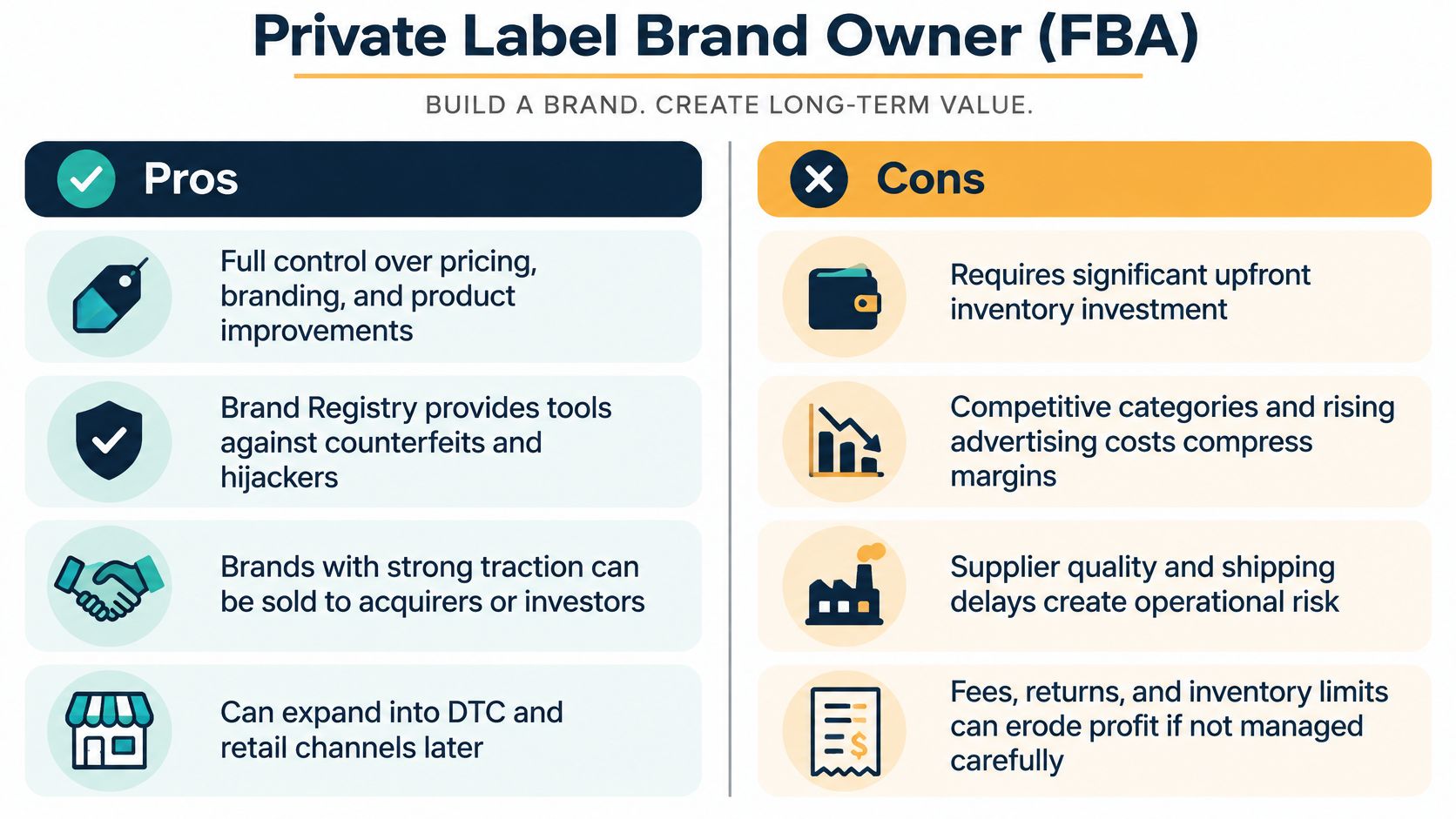
Your cash plan must cover samples, production, freight, duties, fulfillment, returns, and advertising. Model when the next supplier deposit becomes due, not just when the opening shipment might sell out.
The Teikametrics Marketplace Benchmark Report found that sellers increased advertising spend and ad-attributed sales in 2025 while returns softened as acquisition costs rose and conversion weakened. Ad-attributed revenue isn't proof of profitable demand.
If you're evaluating an Irish entity, company formation in Ireland for non-residents belongs in the setup discussion, not as a substitute for tax and operating advice.
A buyer can acquire the brand, supplier relationships, and documented operations. Decision point: Can you fund replenishment while earning contribution profit after advertising? If not, more sales can deepen the cash shortage.
An established household-cleaning brand already has demand. Your job as a wholesale seller is to obtain authentic inventory on workable terms, keep it available, and win orders without repricing away your profit.
You buy from manufacturers, distributors, or brand owners and resell their products. Unlike private label, you don't need to invent the product proposition. You also don't own the brand or have exclusive control over its listing.

Consider an authorized reseller sourcing cleaning supplies from a regional distributor. The attractive opportunity isn't just a discounted case. It's a replenishable catalog with reliable invoices, consistent availability, and enough margin to withstand competing offers.
Before placing an order, inspect the existing listing, competing sellers, price history, and your eligibility to sell. Written authorization and credible supply-chain documentation matter more than a supplier's promise that everyone sells the product.
Wholesale consumes working capital because you pay for inventory before recovering the proceeds. Supplier credit can help, but it doesn't fix products that stop selling at a viable price.
Exit value comes from transferable supplier access, reliable purchasing systems, and a diversified catalog. Decision point: Can you repeatedly replenish profitable stock under terms competitors can't easily erase? Without that, you're buying transactions rather than building a defensible operation.
A price gap is an opportunity only after you verify the exact product and every cost. Online arbitrage sellers buy from retail websites and resell on Amazon. They don't develop products, but they do take inventory, documentation, and pricing risk.
Say a retailer discounts a kitchen appliance. Amazon's listing looks profitable until you notice that the offer includes an accessory your source doesn't supply. Matching the brand and product name isn't enough. Model, pack count, condition, regional version, and included parts must match.
Tools such as Keepa help you inspect historical pricing and sales-rank movement. Use that history to test whether today's apparent margin depends on a temporary shortage or an unusually high selling price.
Sourcing rule: Calculate the purchase against a conservative selling price, not the most attractive price currently on the screen.
Build a sourcing worksheet that includes purchase cost, shipping, preparation, fulfillment, expected returns, and the cash you'll have tied up. Set your required return before shopping so a discount banner doesn't make the decision for you.
Check retailer purchasing restrictions and your Amazon selling eligibility separately. Keep order confirmations and receipts, but recognize that retail documentation may not satisfy every Amazon authenticity or supply-chain request.
This model can fund itself through reinvested proceeds, provided stock sells promptly. Scaling requires repeatable sourcing, receiving, inspection, and reconciliation, not more browser tabs.
An eventual buyer would need your sourcing systems and team; a list of expired deals has little durable value. Decision point: Does the purchase still work after price compression, documentation risk, and sourcing labor? If the profit depends on everything going right, pass.
The clearance aisle is a useful classroom, but an unreliable production line. Retail arbitrage means buying discounted goods in physical stores and reselling them on Amazon, with your time and travel forming part of the acquisition cost.
A typical use case is a founder testing resale with seasonal home goods. They scan products, check listing eligibility, inspect packaging, and buy selectively rather than clearing a shelf because the discount looks impressive.
Use the Amazon Seller app to check the product match and selling eligibility before paying. Review historical demand as well, because a favorable sales rank at the moment you scan doesn't guarantee steady sell-through.
Inspect seals, expiration dates where relevant, packaging condition, and signs of missing components. A damaged box can turn an apparently new product into a condition problem that erases the purchase advantage.
The model teaches listing mechanics, inventory preparation, and pricing without requiring a manufacturing commitment. The trade-off is that replenishment depends on what stores happen to have, so purchasing capacity often follows the founder's available hours.
You can reinvest proceeds into more stock or use the experience to move toward wholesale or private label. Decision point: Are sourcing trips producing worthwhile profit after your labor, and can someone else reproduce the process? If not, you've created a hands-on income stream rather than a readily transferable business.
A vendor sells to Amazon; a marketplace seller sells through Amazon. Under the first-party model, Amazon purchases inventory wholesale and resells it. Your commercial relationship centers on purchase orders, negotiated terms, and operational compliance rather than individual marketplace orders.
For an established personal-care manufacturer, supplying Amazon Retail may fit existing production and distribution systems. But a large purchase order isn't automatically attractive. You must evaluate what you'll collect after contractual deductions and the costs of fulfilling it.
The distinction between Amazon Vendor Central and Seller Central matters because it changes pricing control, cash timing, and who manages the retail offer.
Build a vendor-specific profit statement instead of reusing your marketplace margin model. Include allowances, co-op commitments, freight, potential chargebacks, and payment timing as applicable to your agreement.
You also need an operational owner for purchase-order acceptance, shipment notices, labeling, routing, and reconciliation. A manufacturing team that can produce the goods may still struggle with the administrative requirements of supplying a retailer.
Moving inventory to Amazon doesn't remove commercial risk. It changes the risks you need to price and manage.
Amazon controls its retail selling price, so you give up a lever you'd have as a third-party seller. Hybrid operations can retain flexibility, but they require careful coordination of inventory, offers, and channel economics.
Funding must cover production and the gap before payment, not just the shipment date. At exit, a buyer will examine the economics and continuity of the vendor relationship alongside the underlying brand and manufacturing capabilities.
Decision point: Do the net terms and cash cycle justify the reduced retail control? If you can't reconcile deductions or fund accepted orders reliably, purchase-order growth can become a liability rather than an advantage.
A ceramic bowl competes on more than capacity and color. Buyers may care about the glaze, the maker's process, and the small differences that make each piece distinct. Amazon Handmade works best when the listing explains that distinction without making fulfillment unpredictable.
A small pottery studio, for example, could sell a repeatable core collection while keeping experimental pieces outside its main replenishment plan. That separates dependable products from work that needs individual photography or special handling.

Materials aren't your full cost. Include making, finishing, inspection, photography, packaging, breakage, customer questions, and any personalization work.
Document your process for the Handmade application and describe materials and dimensions clearly. Explain reasonable variation so buyers understand what handmade means for the item they'll receive, rather than discovering it after delivery.
The choice between Amazon Handmade and Etsy should include production workflow and buyer expectations, not just which storefront looks easier to open.
Funding may be tied up in materials and unfinished work rather than factory orders. Exit options depend on whether another maker or trained team can maintain the product quality without the founder performing every task.
Decision point: Can you increase output without underpaying the maker or weakening the craft? If every extra order requires scarce founder time that isn't priced into the product, growth makes the workload larger without making the business stronger.
Selling on Amazon and your own website doesn't automatically create diversification. If both depend on the same product, supplier, and promotional calendar, you may have added complexity without reducing much risk.
An omnichannel operator gives each channel a clear commercial role. Say a skincare brand sells convenient replenishment products on Amazon, offers educational content and curated bundles through its website, and supplies selected retail partners. The assortment and service need to justify each channel's costs.
DTC isn't automatically the higher-margin channel. Website sales carry acquisition, fulfillment, payment-processing, support, and returns costs. Compare contribution profit using consistent definitions rather than contrasting Amazon fees with a website's gross margin.
Set coordinated promotional calendars and lawful pricing policies. Reserve inventory by channel where necessary, with a clear rule for reallocating stock when demand changes.
Build permission-based customer relationships through your own site and marketing. Don't divert Amazon transactions or use marketplace customer information for unauthorized marketing.
If you need specialist help, find the right ecommerce growth consultant by matching the assignment to the bottleneck, such as retention, channel profitability, or inventory planning.
Funding must support overlapping inventory and marketing needs. A buyer may value diversified revenue and owned customer relationships, but will also examine whether the extra channels earn money.
Decision point: Does each channel produce incremental contribution profit and useful customer access? If it merely shifts existing demand into a more expensive workflow, expansion isn't diversification worth funding.
An exit-oriented brand isn't a separate fulfillment method. It's an ownership strategy layered onto a business, often private label, with operations built to survive a change of owner.
Consider a kitchen-accessories founder preparing for an acquisition discussion. Attractive revenue won't resolve unclear supplier ownership, unreconciled inventory, or a listing that depends entirely on undocumented founder knowledge. A buyer needs evidence that earnings and operations can transfer.
The account of what happened to Thrasio is useful context for evaluating aggregator-backed ownership. Don't build a plan that requires a particular buyer type to remain interested when you're ready to sell.
Keep business and personal finances separate. Reconcile settlements, advertising expenses, inventory balances, returns, and supplier liabilities so the profit statement reflects what the business costs to run.
A business that's easy to understand and operate is better prepared for diligence than one that needs the founder to explain every exception.
Funding still comes from operating cash, equity, or debt while you own the brand. A possible acquisition isn't a substitute for sufficient working capital, and a signed agreement may include obligations that continue after closing.
Selling can provide liquidity, but compare proceeds, retained risk, and future involvement rather than treating the headline offer as the whole deal. Decision point: Would you still want to own this business if no buyer appeared? If the answer is no, fix the operating model before optimizing the exit story.
| Item | Brand Ownership | Pricing Control | Upfront Capital | Best For |
|---|---|---|---|---|
| Private Label Brand Owner (FBA) | Owns the brand | Full control | Significant inventory investment | Building a scalable, sellable brand |
| Amazon Wholesale Seller | Resells established brands | Limited; affected by Buy Box competition | Capital for bulk inventory | Sellers seeking established demand and repeat sales |
| Online Arbitrage Seller | Does not own the brands | Limited; dependent on market prices | Low product-development cost; sourcing funds needed | Sellers comfortable with fast, data-driven sourcing |
| Retail Arbitrage Seller | Does not own the brands | Limited; dependent on market prices | Very low startup cost | Beginners learning sourcing and Amazon operations |
| Amazon Vendor (1P) Supplier | Owns or represents the brand | Amazon controls retail pricing | Investment in supply chain and inventory | Established brands equipped for retail-scale supply |
| Handmade and Craft Seller | Owns original creations and designs | Seller sets prices, subject to marketplace fees | Small-batch production investment | Artisans selling distinctive handcrafted goods |
| Omnichannel Brand Operator (Amazon Plus DTC) | Owns the brand | Manages pricing across channels | Larger marketing and team investment | Mature brands diversifying sales channels |
| Amazon Aggregator-Backed Brand (Exit-Oriented Seller) | Owns the brand until acquisition | Brand-controlled before sale; buyer-controlled after | Investment in brand operations and inventory | Founders preparing a brand for acquisition |
The right model is the one you can fund through its difficult phase, not just afford to start. Retail and online arbitrage suit founders who want fast operational learning and can contribute hands-on sourcing time. Wholesale fits operators who can secure credible supply, manage replenishment, and protect margin under competitive pricing.
Private label suits founders willing to fund product development and inventory before demand becomes predictable. Handmade favors makers who can charge properly for skilled work. Vendor supply requires the systems and cash discipline to serve Amazon as a wholesale customer, while omnichannel expansion makes sense when the underlying brand can support additional workflows.
Don't confuse a larger revenue target with a stronger business. Modern Retail's marketplace briefing reports that 49% of surveyed sellers identified marketplace fees as their largest margin concern. Your model needs room for costs you can't wish away.
Start with available capital after keeping a reserve for operating obligations. Map when you pay suppliers, when inventory becomes sellable, when proceeds arrive, and when replenishment payments fall due. That sequence often exposes a funding gap that a product-level profit calculation misses.
Then examine margin headroom and ownership:
Choose one model to test for 90 days. Treat that as an operating experiment, not a promise of profitability. Set a spending cap, define what evidence would justify another purchase, and write down what would make you stop.
For brand equity and potential exit options, private label and acquisition-ready operations offer assets beyond individual inventory purchases. They also demand patience: clean books and documented processes won't rescue weak products or unprofitable acquisition.
At Million Dollar Sellers, our invite-only community focuses on ecommerce operators. Amazon-led applicants must have at least $1 million in trailing-twelve-month Amazon revenue and be a founder or substantial equity holder. For eligible founders, peer discussion can help pressure-test the assumptions behind a model before committing more capital.
Our private community gives ecommerce founders access to operator discussions, topic-focused calls, and peer connections for working through decisions such as replenishment, channel expansion, and exit preparation. Visit Million Dollar Sellers to explore membership and bring a specific operating question to the conversation.
Join the Ecommerce Community for Founders Scaling from 7 to 9 Figures
Learn MoreYou may also like:
Learn more about our events!
Check Events