Chilat Doina
July 28, 2026
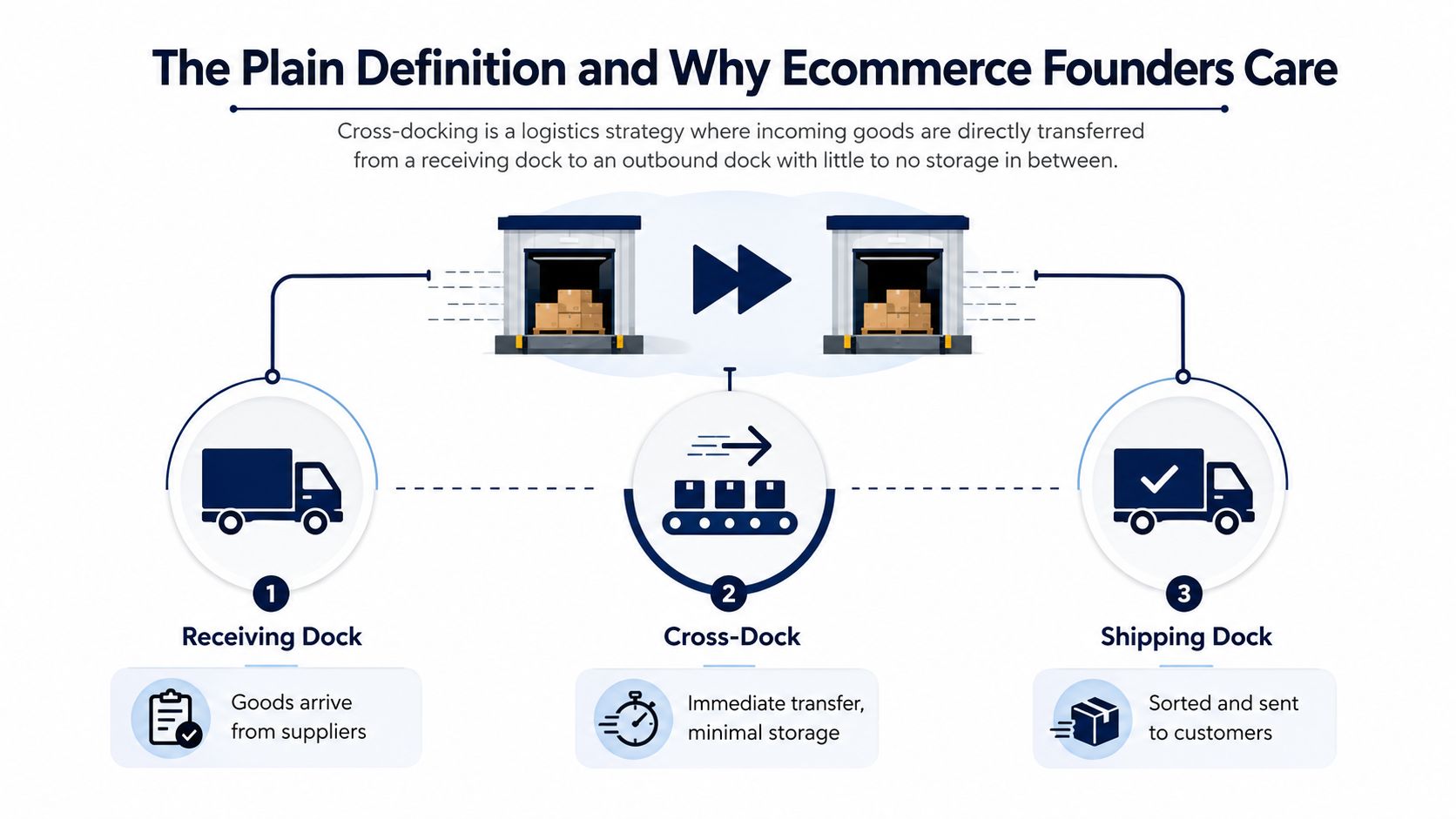
Cross-docking is moving freight from the receiving dock to the shipping dock without putting it into storage first, and the typical dwell window is no more than 24 hours. In practice, that means inventory is in and out so fast that the building works like a transfer point, not a warehouse.
A lot of ecommerce founders start asking about it when palletized inventory is piling up, outbound promises are getting tighter, and the math on holding stock starts to sting. If that sounds familiar, cross-docking may fit your network, but only if your demand, carriers, and systems can keep up.
A brand owner staring at three weeks of palletized inventory usually isn't looking for theory. They're looking at cash tied up in product, floor space they can't reclaim, and a team that keeps getting pulled into put-away, recounts, and re-handling. Cross-docking enters the conversation right there, because it changes the question from “Where do we store this?” to “How fast can we move it through?”
Cross-docking is the logistics process defined by the Material Handling Industry of America as moving merchandise from the receiving dock to the shipping dock without placing it first into storage, with products typically stored for no more than 24 hours (source). That definition matters because this is not just “fast warehousing.” It's a different network design that removes the storage step and focuses the building on rapid consolidation and dispatch.
For ecommerce and omnichannel operators, the attraction is simple. Less inventory dwell means less capital sitting idle, less space needed for storage, and less friction when the promise is speed. It also fits the reality of brands that are selling into multiple channels, where store replenishment, DTC shipment, and regional distribution all demand different handling patterns.
I usually frame it as a network decision, not a warehouse trick. If your freight already consolidates well, if destination patterns repeat, and if inbound timing is predictable, cross-docking can replace a chunk of traditional storage with a tighter transfer flow.
For a plain operational breakdown, the how cross docking works for regional freight explanation is useful because it treats the process as a freight movement problem, not just a facility layout problem. If you're comparing it to broader fulfillment models, the role it plays inside 3PL fulfillment is usually the easiest way to see where it fits and where it doesn't.
Practical rule: if a shipment needs to sit around waiting for someone to decide its destination, cross-docking starts to lose its edge.
That's why founders care. Cross-docking is usually talked about when they're trying to cut dwell, speed line-haul replenishment, and stop paying for storage that doesn't add value.
The three main workflows look similar from a distance, but they behave differently on the dock. That distinction matters because the wrong model can create congestion, missed cutoffs, and more handling than a normal warehouse would have caused.
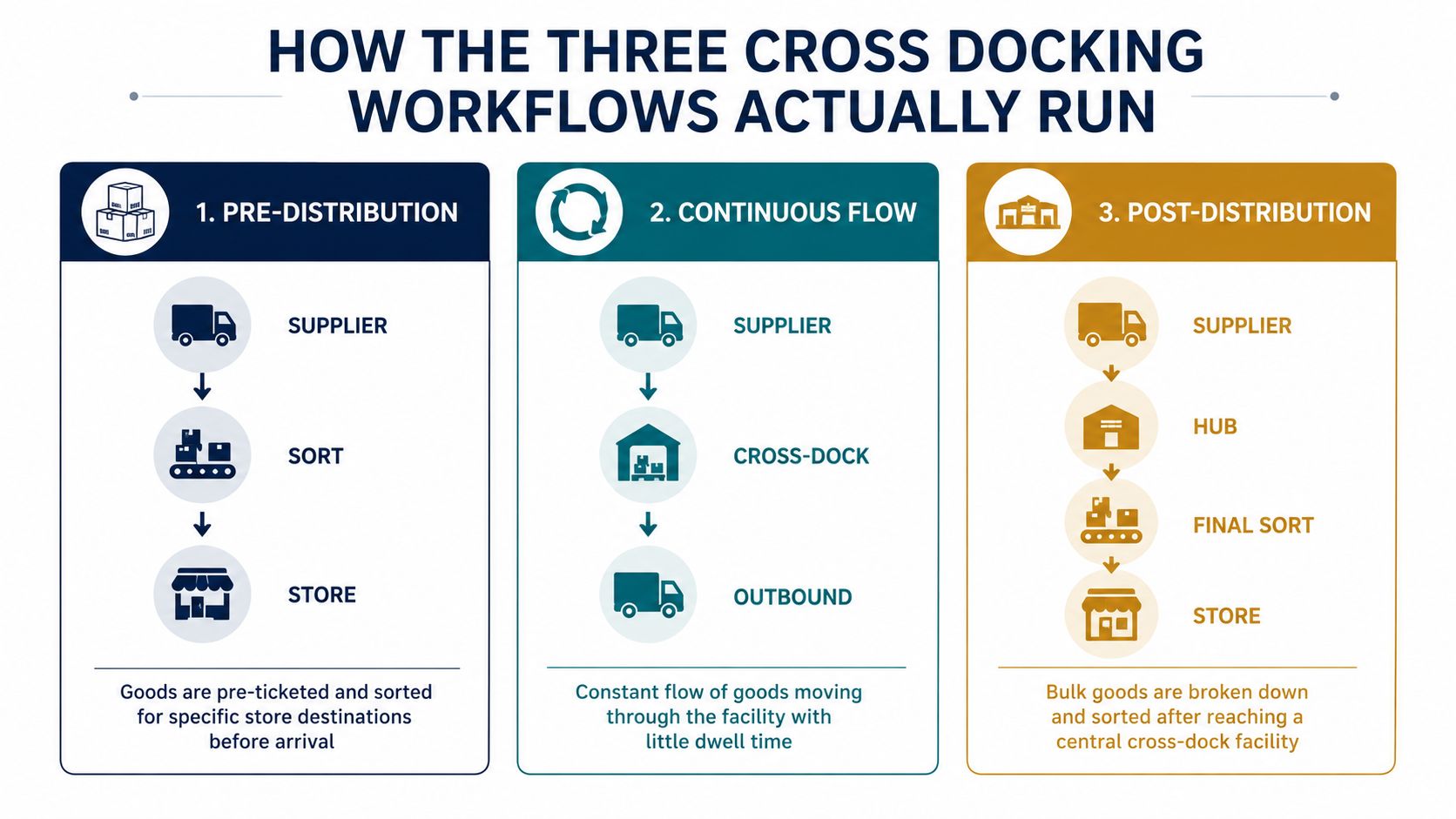
Pre-distribution cross-docking is the cleanest version. Goods arrive already assigned to a store, route, or customer group, then get sorted and pushed out with minimal thinking on site. A national retailer receiving pre-ticketed pallets for specific stores is the classic use case.
That's the right model when your inbound and outbound plans are already locked. The dock team mostly verifies, splits, and reloads. There's very little judgment needed at the building level, which is why this workflow depends so heavily on upstream planning.
Continuous flow is what many operators picture first. Freight comes in, gets transferred, and leaves almost immediately because the inbound and outbound rhythm is already synchronized. For a grocery replenishment lane or a DTC regional replenishment flow, it works best when destinations repeat often and the volume justifies constant movement.
A practical signal is 10–15 pallets per day going to similar destinations, because that's the point where the consolidation payoff starts to make sense (source). Below that, the labor and scheduling overhead can eat into the benefit.
Post-distribution is more flexible. Bulk freight comes in, then the facility breaks it down after arrival based on inventory position, customer demand, or routing needs. Amazon prep-and-consolidate flows often resemble this logic when inbound product needs to be grouped, labeled, or redirected before final movement.
That extra flexibility costs you time, though, because the operation now needs stronger sortation, better visibility, and tighter exception handling. It's useful when demand is real but not fully pinned down before the truck arrives.
The upside is real, but it only shows up when the flow is disciplined. Cross-docking is usually worth serious attention only when freight consolidates well, demand is predictable enough to plan around, and the operation can keep dwell time tight without turning the dock into storage by another name. That is why operators keep coming back to it for fast-moving, repeatable freight.
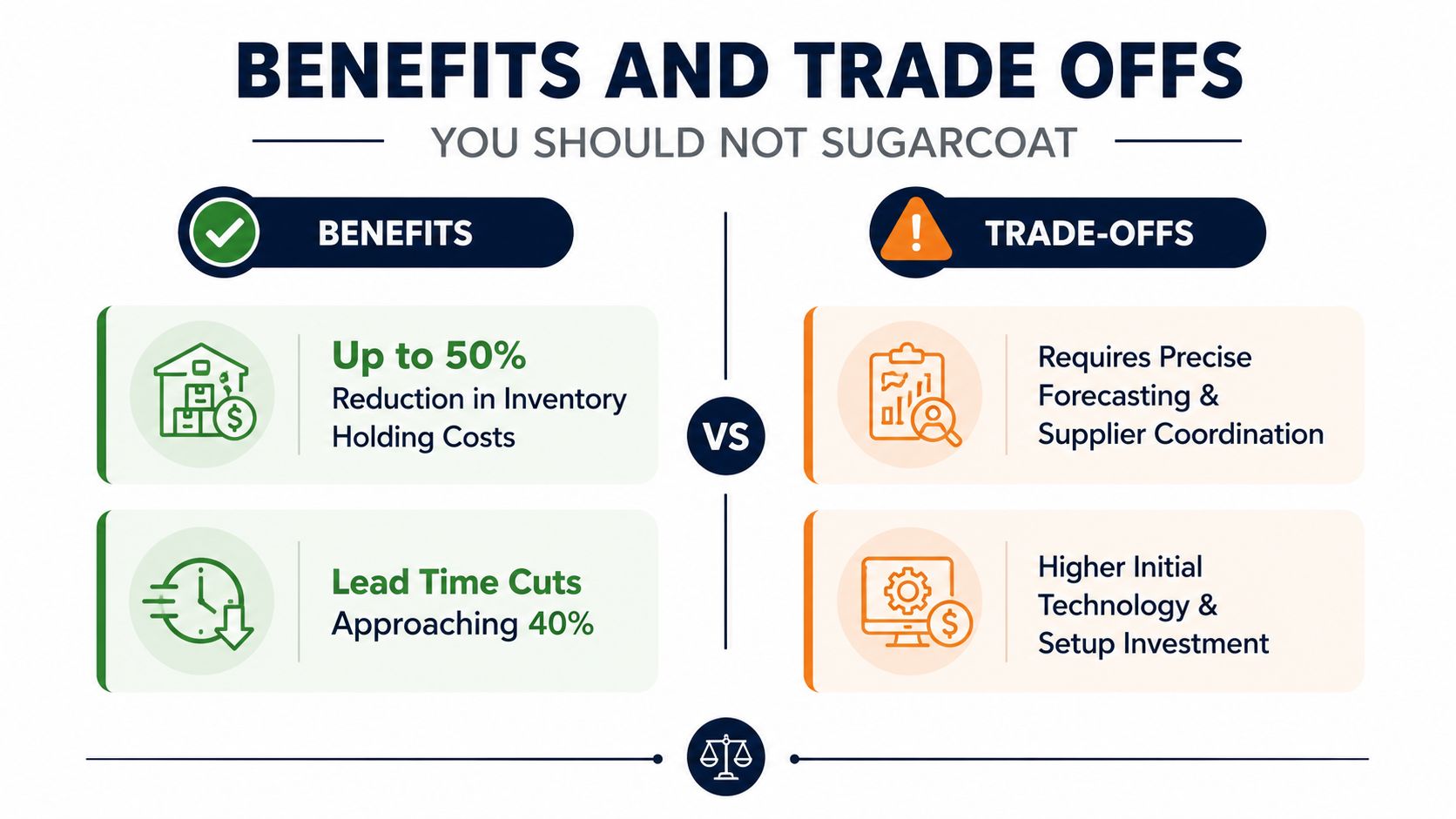
The biggest gain is that you stop paying for storage that does not contribute to the sale. Once freight is treated as transfer cargo instead of stock to be held, the building needs less reserve space and less re-handling. That also improves truck fill, because the whole point is often to consolidate smaller inbound shipments into fuller outbound moves.
For ecommerce brands, that can be especially useful with pre-sold inventory, promotional spikes, and supplier consolidation. Those flows already have a destination or demand signal attached to them, which is why they fit the model better than random replenishment. I have seen the cleanest results when a brand has repeat lanes, stable order profiles, and enough daily volume to keep freight moving through the dock instead of waiting on the floor.
The trade-off is severe when the plan slips. Cross-docking depends on demand being known or tightly forecasted, plus system-directed allocation, scan-confirmed movement, and dock coordination rather than later put-away and retrieval (source). If an inbound truck misses the outbound cutoff, the time advantage disappears and the freight may need temporary staging or exception handling.
That is where a lot of brands misread the model. They assume the dock can sort it out on arrival, but cross-docking punishes improvisation. The more your flows depend on forecast quality and carrier punctuality, the more the savings hold. The less stable your inputs are, the more the system turns into a busy, fragile staging area.
The network design question is simple. If freight is already headed to a specific destination and the outbound path is clear, cross-docking can cut handling and reduce idle inventory. If demand is still fuzzy, the extra touches and coordination can erase the benefit quickly. For operators weighing providers, best 3PL for ecommerce is the kind of resource that helps pressure-test whether the dock setup is ready for that discipline.
Operational reality: cross-docking saves money when the freight is already headed somewhere specific. If the destination is still being debated at the dock, you are paying the complexity tax without getting the speed benefit.
A brand that is growing fast usually ends up with two workable paths. It can build cross-dock capability into its own operation, or it can let a 3PL run the dock and plug the freight into an existing network. The better choice comes down to freight volume, how much control the team needs over exceptions, and how much capital can be tied up in doors, labor, and software without slowing the rest of the business.
For a lot of ecommerce brands, the practical starting point is the partner network. That keeps fixed costs lower while the flow is still proving itself, and it avoids building a dock around a pattern that may still change. If you are comparing providers, best 3PL for ecommerce is useful for checking whether a partner can handle dock coordination instead of only talking about storage and pick, pack, ship.
| Monthly Volume | Smarter Default | Capital Needed | Control Level |
|---|---|---|---|
| Low, irregular, or seasonal | 3PL | Low | Moderate |
| Moderate with repeat destinations | 3PL, then review in-house later | Medium | Moderate to high |
| High, stable, and destination-heavy | In house or dedicated 3PL setup | Higher | High |
| Promotional or spike-driven | 3PL with strong exception handling | Low to medium | Moderate |
A useful rule of thumb is that in-house cross-docking starts to make sense when the freight pattern is repeatable and the dock will be busy every week, not only during peaks. If the flow is still uncertain, the labor and layout can sit idle, and the fixed cost becomes hard to justify. If the movement is already steady, the same control can reduce touches and shorten dwell time.
A 3PL brings carrier relationships, appointment discipline, labor, and dock space that the brand does not have to fund on its own. The trade-off is that visibility depends on the provider's WMS, its sortation rules, and how well exceptions are pushed back to your team.
That usually works when flexibility matters more than direct control. It becomes harder to live with if the brand runs tight launch calendars, has brittle promotion windows, or needs same-day issue resolution around labeling, routing, or lane assignment. In those cases, the model can still work, but only if the operator is disciplined and the handoff data is clean enough to avoid manual chasing.
A good 3PL also needs the process maturity to hold freight at the dock without letting it drift into temporary storage. Once that happens, cross-docking starts to look like a standard staging warehouse, and the cost advantage gets thinner.
When your own team owns the dock, the brand gets more control over exception handling and more freedom to tune the process around the product mix. That is useful when the freight pattern is repetitive, the outbound destinations are known, and the team can run cutoffs with discipline. The cost side is less forgiving, because the business now carries the capital burden, the labor training, and the risk of a poor layout.
The layout matters more than most founders expect. If the dock doors are not mapped cleanly, the scan flow is weak, or the team does not understand the outbound cutoff, the building slows down quickly. A house dock can run very efficiently, but only when the systems, people, and inbound timing are all aligned.
For operators who want to benchmark the system side before committing, the simplest test is whether your warehouse management setup can direct work cleanly enough to support master warehouse management integration without forcing the team back into spreadsheets and calls.
Rule of thumb: build in house when the freight pattern is stable enough that the investment will be used every week, not just during peaks.
Cross-docking lives or dies on coordination. Without the right stack, it becomes manual triage with a forklift. The minimum viable setup is a WMS, a scheduling layer for inbound and outbound transport, scan hardware at every touch, and dock appointment timing that keeps the flow moving.
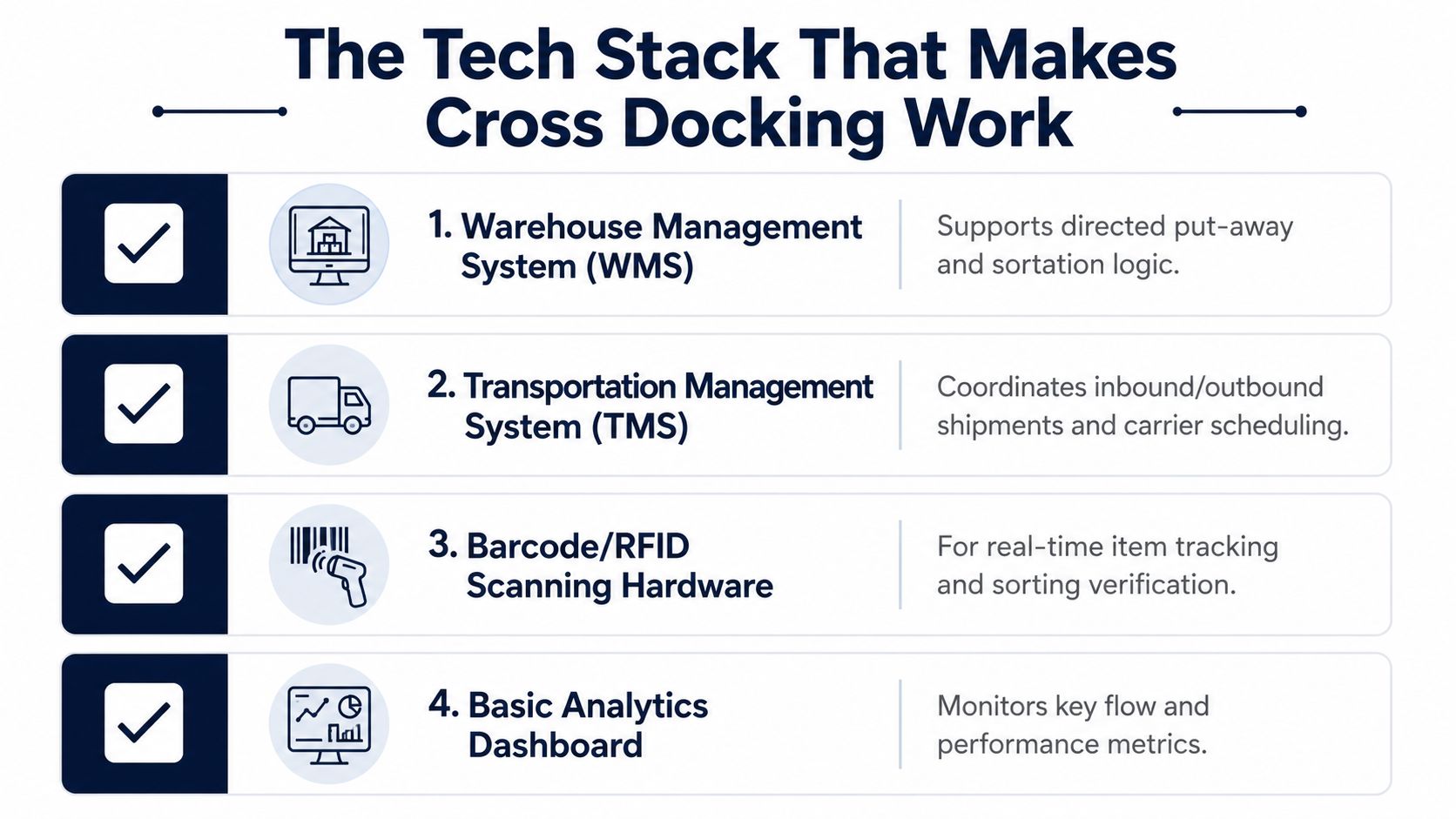
The Warehouse Management System has to support directed sortation, not just inventory visibility. That matters because cross-docking depends on the building knowing where freight should go before someone starts moving pallets around. If your WMS can't direct the work, the dock team ends up improvising.
The same goes for scan-confirmed movement. Barcode or RFID confirmation at every touch keeps freight from drifting into the wrong lane, and it gives the team a live picture of what has already been allocated. A TMS or carrier scheduling layer is the other hard requirement, because outbound timing is what makes the whole model pay off.
The pain point is almost never the idea of cross-docking. It's the handoff between systems. When the WMS doesn't speak cleanly to the TMS or to a 3PL portal, the team falls back on spreadsheets, email cutoffs, and manual exceptions, which defeats the point.
That's why integration discipline matters as much as dock layout. If you're mapping software options, the warehouse management system integration resource is a good reminder that the tech stack has to be operationally connected, not just “installed.”
Basic analytics dashboards help you see dwell trends, missed cutoffs, and dock congestion, but they're only useful after the core workflow is stable. I'd rather see a small, accurate system than a flashy one that can't direct freight properly.
For teams comparing platforms, warehouse management systems is a useful benchmark because the core question isn't feature count. It's whether the software supports the exact movement pattern your dock needs.
If the model is working, the numbers show it quickly. The first thing I look at is dwell time, then I check whether freight is making the right outbound trailer without extra touches. Those two metrics usually tell me more than a polished dashboard ever will.
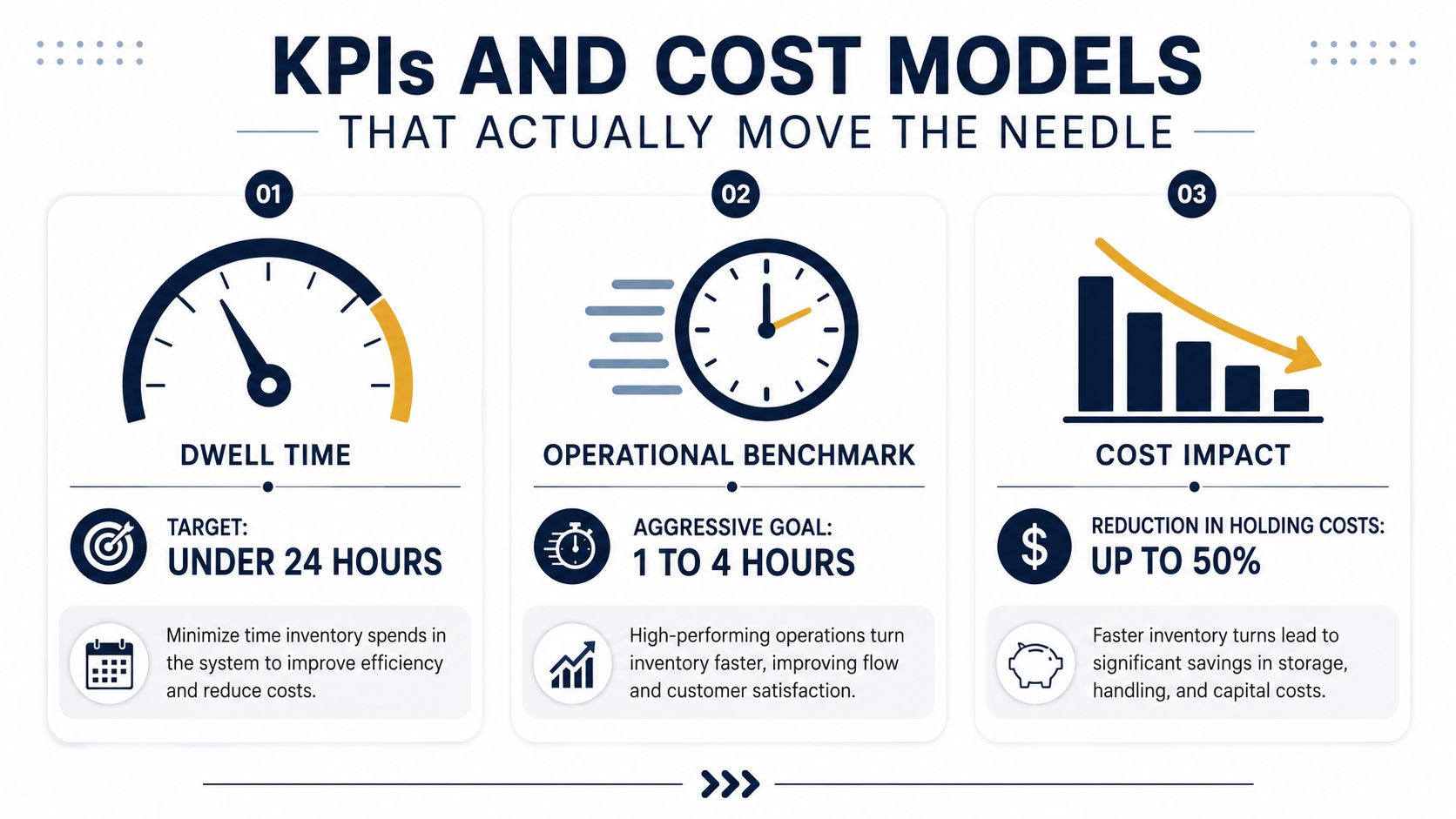
Dwell time should sit under 24 hours, with many operations aiming for 1 to 4 hours because the facility is built to minimize touches and staging (source). That's the cleanest measure of whether the cross-dock is functioning as a transfer node rather than a storage node.
Other useful metrics are dock-to-stock ratio, truck fill rate, cost per order through the cross-dock, and on-time shipment percentage. Each one ties back to a different lever. Dwell time reflects scheduling discipline, fill rate reflects consolidation rules, and cost per order reflects dock-door productivity.
Peak periods change the math, but they don't change the basics. Some metrics can flex temporarily, like fill rate or exception volume, if the business is intentionally pushing through promotional freight. Dwell time and on-time shipment still need to stay tight, because once freight starts sitting around, the network loses the advantage that justified the cross-dock in the first place.
A good operating review should ask one simple question first. Did the freight leave on the intended schedule? If the answer is no, everything downstream gets more expensive.
Best practice: fix scheduling before you chase labor efficiency. If trucks arrive and depart out of sequence, faster pickers just create faster congestion.
Cross-docking is a yes only when three things line up. The target SKUs need forecast stability, the inbound volume needs to repeat to similar destinations, and the business has to tolerate short-term exception staging when reality slips. If one of those is missing, the model gets fragile fast.
It's usually the wrong choice for long-tail SKU catalogs where demand is hard to pin down, for single-channel businesses with erratic flow, and for teams that don't have a WMS capable of directed sortation. In those cases, the building ends up acting like a messy staging area, and the economics deteriorate.
The other red flag is a brand that wants the speed benefit without the planning discipline. Cross-docking doesn't reward ambiguity. It rewards pre-allocation and timing.
If the answer is yes, start with a narrow SKU set that already moves to repeat destinations. Map the dock doors first, then wire the freight rules into the WMS and carrier schedule so the team sees the same plan in every system. From there, run a 30, 60, 90 day review cadence and watch whether dwell, cutoffs, and exception volume are tightening or slipping.
The quickest way to get this wrong is to pilot too much at once. Keep the first wave small, measure accurately, and let the process prove itself before you expand.
If you want sharper operator-level context on freight, fulfillment, and scaling decisions, Million Dollar Sellers brings together founders who live in these trade-offs every day. It's a useful place to pressure-test whether cross-docking belongs in your network or whether a different fulfillment move will get you there faster.
Join the Ecom Entrepreneur Community for Vetted 7-9 Figure Ecommerce Founders
Learn MoreYou may also like:
Learn more about our special events!
Check Events