Chilat Doina
March 6, 2026
At its most basic, retail arbitrage is the classic "buy low, sell high" model. You’re essentially on a modern-day treasure hunt, but instead of a dusty old map, your guide is the clearance aisle at Target, Walmart, or your local discount store. You find a product selling for cheap and resell it online for a profit.
Simple enough, right? But for established sellers, thinking of it as just a simple flip is a mistake.
For a growing e-commerce business, retail arbitrage isn't the main army—it's your special ops team. You don't send it to fight the whole war. You deploy it for quick, strategic missions that give your larger operation a serious edge.
This mindset gives you two huge advantages:
Think of those clearance aisles as your personal product testing lab. You get real-world sales data on what’s hot, letting you spot and jump on market gaps that bigger, slower-moving sellers completely miss.
The mechanics are straightforward, but making real money requires a system. If you're just starting out, getting a handle on the fundamentals is key, and a solid guide on how to start a reselling business can give you that foundational overview.
The whole game is built on price gaps between what a brick-and-mortar store is asking and what a customer on Amazon is willing to pay. For example, you might find a popular toy on clearance for $10 at Walmart that you know consistently sells for $35 on Amazon. You buy every one they have, list them, and after fees, you pocket the difference. It's a powerful and low-cost way to get started or add a new revenue stream to your existing business.
On the surface, retail arbitrage seems almost too simple: buy low, sell high. But any serious seller knows the difference between a lucky find and a real business is a solid, repeatable process. This isn't about aimlessly wandering through clearance aisles; it's about building an efficient loop that turns store shelves into a consistent source of income.
The whole operation really comes down to three main stages: Sourcing, Listing, and Fulfillment. Getting all three right is what separates the hobbyists from professional sellers who truly understand what is retail arbitrage is as a business model.
The hunt starts in a regular brick-and-mortar store, but your most valuable tool isn't the shopping cart—it's your phone. The real brains of the operation are the scanning apps that turn a simple barcode into a flood of actionable data.
When you scan an item, these apps tap right into Amazon's marketplace and show you everything you need to know in seconds:
This data-driven approach takes all the guesswork out of the equation. You stop buying on a hunch and start making smart investments backed by real-time market facts.
This simple flowchart breaks down the entire cycle.
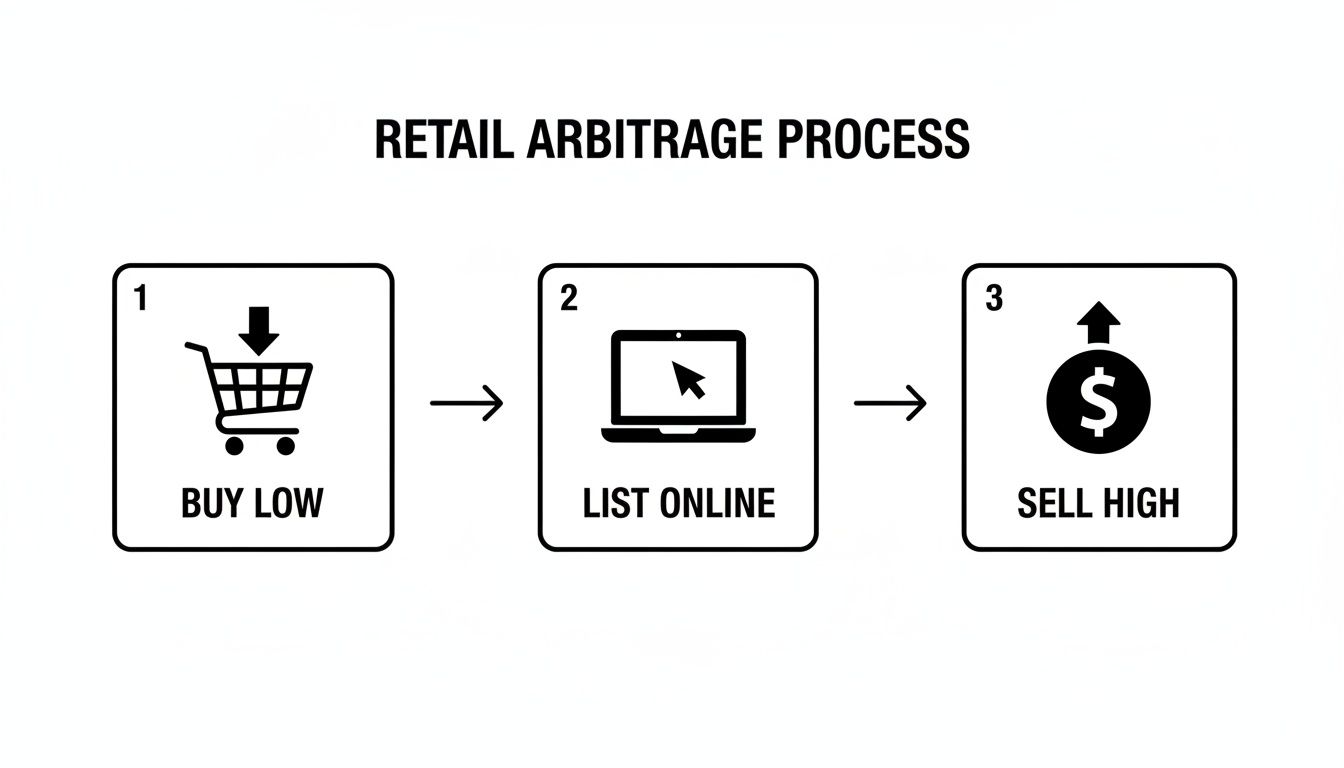
As you can see, it’s a strategic cycle. You’re taking products from a local shelf and plugging them directly into a global online marketplace.
Finding profitable inventory is just the first half of the battle. Next, you have to get it listed and sold. A good listing is more than just a price and a picture; it's about pricing competitively to win the all-important Buy Box.
But here's the real secret to scaling: Fulfillment by Amazon (FBA). Instead of you packing and shipping every single order from your garage, you send your inventory in bulk to an Amazon warehouse.
With FBA, you’re essentially outsourcing your entire logistics operation. Amazon takes care of the storage, packing, shipping, and even customer service. Plus, your products automatically become Prime-eligible, which is a massive sales booster.
This is a complete game-changer. It frees you from the daily grind of fulfillment so you can spend your time on what actually makes you money: sourcing more great products.
The numbers don't lie. In 2025, an incredible 58% of new Amazon sellers became profitable in their first year, and over 25% of all sellers rely on arbitrage. This success is hugely propped up by the FBA model, with third-party sellers now accounting for 61-62% of all paid units sold on the platform. You can dig into these seller statistics and see how arbitrage is fueling so much of that growth. This whole system turns retail arbitrage from a simple hustle into a self-funding engine for product research, generating both cash and valuable market data at the same time.

Anyone can wander through a clearance aisle, but the pros know that successful sourcing is a data-driven hunt. It’s about spotting market gaps the big retailers missed. The real difference between a profitable sourcing trip and a wasted afternoon comes down to one thing: a system.
Forget relying on luck. Your smartphone, armed with a good scanning app, is your most important tool out in the field. It’s your window into real-time profit margins, Best Sellers Rank (BSR), and the competition you're up against. This is how you stop guessing and start making decisions based on cold, hard data.
A solid sourcing strategy isn’t just about chasing one-off "treasure hunts." To build a real business, you need a balanced portfolio of products. Think of it as mixing reliable, everyday wins with those occasional high-reward finds.
Here’s what a professional sourcing playbook looks like:
To really get an edge, you need to know what your competition is up to. Effective competitor price monitoring is non-negotiable; it’s how you spot pricing gaps before anyone else does.
Once you've got the basics down, you can start layering in more advanced tactics. They take a bit more effort, but the payoff can be huge.
For seven-figure sellers, retail arbitrage is an incredible, low-risk way to test new products. A typical ROI can easily hit 30-100% or more on a single item, which blows wholesale's steady 15-25% margins out of the water. With fewer active sellers in the market today, there’s now 31% higher traffic per seller, creating a massive opportunity for those still in the game. You can see the full breakdown by exploring the full report.
A pro-level tactic is learning the markdown schedule of your local stores. Some mark down inventory on Tuesday mornings, others on Friday afternoons. Knowing that schedule means you get first pick of the best deals before your competition even shows up.
Building relationships with store managers can also be a complete game-changer. A friendly chat might get you a heads-up on a big upcoming clearance event or even give you access to overstock that hasn't hit the shelves yet. Don't underestimate this human element. For specific ideas, check out our guide on how to sell on Target.
Ultimately, mastering the hunt means building a repeatable system. It’s about knowing your categories, trusting the data from your scanning app, and creating a balanced product portfolio. That’s how you turn sourcing from a game of chance into a predictable engine for growth.
Retail arbitrage can be a fantastic way to generate quick cash flow and test the waters with new products. But let's be honest—it’s far from a risk-free strategy. For any serious seller, knowing how to handle these risks is what separates a profitable business from a suspended account. The game has changed, and you can't afford to ignore the pitfalls.
The real challenge isn't just about finding a great deal anymore. It's about successfully navigating the maze of brand rules and marketplace policies that can trip you up. To win at this, you need to be just as good at playing defense as you are at finding opportunities.
One of the biggest headaches for any arbitrage seller is brand gating. This is when a brand officially tells a platform like Amazon, "Hey, only our authorized partners can sell our stuff here." If you try to list a gated product without permission, you'll hit a wall, and that shiny new inventory you just bought is now stranded.
Even worse are intellectual property (IP) complaints. This is a formal claim from a brand owner accusing you of infringing on their trademark, usually because you're selling their products without being an official dealer.
A single, unresolved IP complaint can put your entire seller account in jeopardy. Amazon treats these as serious violations, not just a simple listing error, and you’ll need to act fast to resolve them.
It's crucial to know the difference here. A soft category restriction is an annoyance that just stops you from listing the item. A hard IP claim, on the other hand, is a direct threat to your business's existence and can lead to a full suspension.
The only way to deal with these issues is to get ahead of them. Crossing your fingers and hoping for the best isn't a business plan. You need a rock-solid process to spot and avoid these risks before you spend a single dollar on inventory.
Here’s a simple but effective framework to build into your sourcing trips:
Beyond getting flagged by Amazon, retail arbitrage has its own set of operational risks that can chew through your profits if you aren't careful. These are the self-inflicted wounds that can be just as painful as an IP complaint.
Challenges loom large in today's market, with increased brand gating in 2026 restricting unauthorized resales, which has spiked IP complaints and created inconsistent supply chains. This environment often sparks intense buy box wars. However, there's a silver lining: the higher demands for preparation, such as hiring a 3PL, have caused many casual flippers to exit the game. This has lowered the overall competition compared to 2024 levels, fattening margins for data-savvy players who can sidestep price crashes from oversaturated scans. You can discover more insights about the state of retail arbitrage on goaura.com to see how the landscape is changing.
Here are three common ways sellers shoot themselves in the foot:
By systematically tackling these policy, operational, and financial risks, you can turn retail arbitrage from a high-stakes gamble into a calculated part of your business strategy.
Running around scanning items will get you started, but that manual hustle has a ceiling. True scale in retail arbitrage is built on smart systems and technology. If you want to stop trading your time for dollars, you have to embrace a tool stack that automates the grunt work and gives you the data for better decisions. This is the pivot from being a busy operator to a real business owner.
At its core, this shift is about creating a workflow where technology does the heavy lifting. It frees you up to focus on the things that actually grow the business, like finding new product niches or building relationships. Without these systems, you eventually become the bottleneck, and your growth grinds to a halt.
To take your operation from a side hustle to a professional business, you need a suite of tools that talk to each other. This isn't about making things more complicated; it's about building a well-oiled machine where every step, from sourcing to sale, is as efficient as possible.
Your essential toolkit really boils down to three key areas:
The goal isn't just to work faster; it's to work smarter. A professional tool stack gives you the leverage to manage a significantly larger inventory with less personal effort, transforming your operation into a managed business asset.
For sourcing, apps like Scoutify 2 or SellerAmp are the industry standard for a reason. They turn your smartphone into a powerful data terminal, instantly showing you an item’s sales rank, who you’re competing against, your potential profit, and any brand restrictions. This immediate feedback helps you avoid bad buys that can sink your profits. You can also check out other powerful Amazon product research tools to see what fits your style.
Once your products are listed on Amazon, the game shifts to actually getting the sale. This is where AI-powered repricers like Aura or Bqool become critical. They work 24/7, automatically adjusting your prices based on your competitors’ moves and rules you set. They fight to capture the Buy Box at the highest possible price, saving you from the impossible task of manually repricing hundreds of listings.
The final, game-changing step to breaking through any growth ceiling is outsourcing your prep and fulfillment. While Amazon FBA handles the final delivery to the customer, you’re still on the hook for receiving, inspecting, labeling, and boxing your inventory to send to Amazon. This is where a third-party logistics (3PL) provider, or a prep center, becomes your best friend.
A prep center handles all that hands-on work. You can ship items you buy online directly to them, or drop off inventory from your local sourcing trips. They’ll inspect it, label it, and pack it all up according to Amazon's strict rules before forwarding it to an FBA warehouse. This one move can completely remove you from the physical logistics, allowing you to run your entire business from a laptop. It’s the key to true location independence and, frankly, unlimited scale.
For anyone serious about building an e-commerce empire, thinking of retail arbitrage as the end goal is a mistake. It’s better to see it for what it is: an incredible launchpad. While the model is fantastic for generating quick cash and learning the market without much risk, its built-in limitations will eventually hold you back from building a massive, eight or nine-figure business. Knowing when it’s time to evolve is the key to long-term, sustainable growth.
The biggest challenge with retail arbitrage? It just doesn't scale. Your growth is handcuffed to the number of hours you or your team can physically spend hunting for deals in brick-and-mortar stores. You’re always at the mercy of local inventory, store hours, and how many good shoppers you can find.
So, when does retail arbitrage stop being your main hustle and start becoming just another tool in the toolbox? The signs are usually pretty obvious. If you're running into the same frustrating roadblocks time and time again, you’re likely hitting the model's natural limits.
When these problems start to feel like your new normal, it’s a clear signal to pivot. But you're not starting over. All that data you’ve worked so hard to collect is now your most valuable asset, giving you the power to de-risk your next, much bigger move.
The real magic of retail arbitrage for a high-level seller is the intel it provides. You're not just guessing what people want; you're validating market demand with actual sales, giving you the confidence to go big on a more scalable model like wholesale or private label.
Moving past retail arbitrage means graduating to business models built for true scale and long-term stability. The on-the-ground knowledge you gained proves what sells—now it’s just a matter of locking down a reliable, scalable supply chain for those very same products.
The two most logical next steps are wholesale and private label. For sellers weighing this evolution, our guide on arbitrage vs wholesale dives deep into the pros and cons of each. Think about it: if you consistently sold out of a specific brand of kitchen gadget, you can use that sales data as leverage. Walk up to that brand and apply for a wholesale account. You're no longer just some random person—you're a proven sales channel with the numbers to back it up.
Ultimately, for a truly sophisticated e-commerce business, retail arbitrage finds its forever home as a tactical, specialized division. It’s perfect for testing new product categories, opportunistically liquidating a competitor's stock, or funding new ventures with a quick cash injection. By making it just one part of a multi-pronged strategy, you build a resilient and durable business that can withstand far more than one built on clearance aisles alone.
Even for sellers who've been in the e-commerce trenches for years, retail arbitrage can bring up some questions. The game has changed. It's less about luck and more about having the right systems in place. Let's tackle some of the common questions we hear from high-level sellers.
Yes, but the playbook is completely different. Profitability in 2024 isn't about stumbling upon a clearance deal anymore; it’s about making data-backed sourcing decisions. The casual competition has mostly faded, but serious sellers now rely on advanced tools to check sales rank, competitor stock, and potential IP flags before a single dollar is spent.
The goal has shifted from finding one "holy grail" product to consistently sourcing a portfolio of items with a solid 30-50% ROI after all your fees and costs are baked in.
For an established brand, retail arbitrage is a sharp strategic tool, not just a way to make a quick buck. Think of it as a low-cost market intelligence operation. You can dip your toes into new categories or test demand for related products before you commit to a massive wholesale order or a new private label run.
It's also a fantastic way to generate cash to fuel other parts of your business. A small, dedicated team or a well-managed 3PL can run an arbitrage "side hustle" that's almost completely separate from your core operations, feeding profits right back into your main brand.
Suddenly, the clearance aisle at Target becomes your low-risk R&D lab.
The single biggest scaling killer is getting stuck in the "solopreneur" mindset. Too many sellers hit a ceiling because they insist on doing everything themselves—the scanning, the prepping, the shipping. When you are the system, your own time becomes the bottleneck.
To scale successfully, you have to build a system that works without you being involved in every single step. This means putting the right tech and the right people in place to handle the grunt work.
A scalable system needs two key things:
If you don't make that shift from being an operator to being an owner, your growth will stall out. Your profits will get crushed under the weight of your own inefficiency—the exact opposite of what you're trying to achieve.
At Million Dollar Sellers, we're all about building systems, not just chasing one-off sales. Our community is built exclusively for top e-commerce entrepreneurs who are past the solopreneur grind and focused on creating scalable, resilient businesses. If you're a 7, 8, or 9-figure seller who wants to connect with peers operating at the highest level, learn more and see if you qualify to join us.
Join the Ecom Entrepreneur Community for Vetted 7-9 Figure Ecommerce Founders
Learn MoreYou may also like:
Learn more about our special events!
Check Events