Chilat Doina
April 20, 2026
You know the feeling. Revenue is still healthy, the team is busy, and every dashboard says something different. Your media buyer wants more budget. Your ops lead wants cleaner forecasting. Your head of growth wants a new channel. None of that is wrong, but generic ecommerce advice stops being useful when you're already running a real machine.
At that stage, you don't need more content. You need better signal.
That's why the operators podcast matters. Not as entertainment, and not as founder inspiration. It matters as a competitive intelligence feed. The best episodes give you access to how serious operators think through attribution, creative, team structure, channel risk, and scale. If you're short on time, the win isn't listening to everything. The win is learning how to pull the right insight out of the catalog and convert it into action inside your business.
A lot of founders hit the same wall. The business is past the early scramble, but not everything compounds cleanly anymore. Paid social gets noisier. New channels look promising until they don't. Team complexity rises faster than clarity. At that point, polished podcast interviews with broad advice become background noise.
The operators podcast cuts through that because it comes from a different place. It was launched in 2023 and is built around insights from a rumored WhatsApp group of entrepreneurs with at least $100 million in annual revenue. As of early 2026, it has an estimated 28,000 monthly listeners and 177 episodes, according to the Apple Podcasts listing for Operators. That consistency matters more than hype. You get an ongoing stream of operator conversations, not a one-off founder victory lap.
Most business podcasts talk about outcomes. This one spends more time on decision quality. That's the difference.
When experienced founders listen, they're usually not hunting for a tactic to copy line for line. They're listening for:
That makes the podcast useful even when an episode isn't directly about your category.
Practical rule: Listen for the underlying operating principle, not the surface tactic. The channel may differ. The logic often transfers.
Founders at scale don't have a content problem. They have a filtering problem.
The best use of the operators podcast is to treat each episode like a private market brief from people operating with larger budgets, broader channel exposure, and harder consequences for bad decisions. That doesn't mean every recommendation fits your business. It means the show gives you a faster read on what high-performing teams are testing, debating, and abandoning.
If your week is packed, that's enough reason to pay attention.
The core appeal of the operators podcast isn't mystery. It's access.
The show's model centers on democratizing exclusive knowledge by transcribing and distributing insights from elite circles, including operators from brands like Ridge, HexClad, and Jones Road Beauty. That approach reduces the information gap between tier-1 founders and growth-stage brands, as described in this first-anniversary analysis of Operators.
The nine-figure threshold matters because it changes the nature of the conversation. Once a brand operates at that level, the problems stop being beginner problems. The issues become organizational. Measurement gets harder. Creative throughput matters more. Inventory, cash, talent, and channel coordination all start colliding.
That's why the strongest episodes feel less like interviews and more like overheard operator meetings.
Instead of polished storytelling, you get a closer look at things like:
A lot of founders say they want transparency. What they usually mean is they want specifics. Operators gets closer to that than most shows because the premise is built on circulating ideas that used to stay inside tighter circles.
You don't need to qualify for the rumored WhatsApp group for the content to be useful. You need the discipline to translate it.
For founders in the messy middle, especially those building toward larger scale, the advantage isn't pretending you're already a nine-figure company. It's seeing how those companies think before you lock in bad habits. That's also why communities of experienced founders have become valuable reading alongside public content. If you're looking for more perspective from peers navigating similar pressure points, this roundup on ecommerce founders and what they actually face at scale is worth reading.
The real edge isn't copying elite operators. It's shortening the time between hearing a strong idea and testing the version that fits your business.
The podcast works when you approach it with that mindset. If you expect turnkey tactics, you'll get mixed results. If you treat it as a live archive of how serious operators reason through hard trade-offs, you'll get far more out of it.
The catalog is deep enough that most founders will waste time if they start at random. The smarter move is to match episodes to the bottleneck in front of you. If growth is stalling, listen for strategic resets. If your reporting stack is muddy, go straight to measurement discussions. If you're thinking about category expansion, focus on episodes where operators talk about scale decisions under pressure.
For anyone building a short list, this is a cleaner starting point than browsing the full feed or generic lists of the best ecommerce podcast options for founders.
A lot of people consume podcasts in chronological order. That's fine for fans. It's a weak strategy for operators.
Use this filter instead:
| Strategic Topic | Episode Title & Guest | Core Insight |
|---|---|---|
| Scaling fast | $0 to $108M in Under a Year: Danny Yeung, CEO of IM8 | Useful for understanding how operators frame speed, focus, and execution when a brand is moving quickly. The YouTube version of this episode has 71,000 views, which signals strong operator interest in the topic, noted in the Operators YouTube catalog and year-in-review context. |
| Market intelligence | 2025 Year in Review with Austin Harrison and Andrew Kaszuba | Best for founders who want current platform signal. This episode discusses Northbeam data from 1,000+ DTC brands, including 15% revenue growth for $100M+ brands, declines for brands under $5 million, 176% year-over-year growth in AppLovin ad spend, a 46% collapse in Snapchat, and 1,000% growth in AI search traffic that still remains a small share of visits. |
| Plateau management | Operator Playbook for Surviving Stalled Growth | Useful when the issue isn't launch velocity but what to cut, simplify, or rework after growth flattens. The value is less about channel tricks and more about how operators think under constraint. |
| Analytics rigor | Episodes featuring Krishna Poda and the analytics stack discussions | These are the episodes to play when your attribution debates are getting circular. They push teams beyond static reports and toward validation methods that reduce false confidence. |
Don't hand this list to your team and hope for osmosis. Assign episodes by function.
A founder should listen for strategic assumptions. A growth lead should listen for testing logic. An ops leader should listen for what has to be standardized for scale. Then compare notes in the same meeting. That's how one episode turns into aligned action instead of scattered interpretation.
A simple way to process each listen:
That last part matters. A podcast only becomes useful when it changes a real decision.
The biggest mistake listeners make is treating the operators podcast like a tactics vault. The better way to use it is to extract the frameworks behind the tactics.
One of the clearest recurring frameworks is measurement. The show details a specialized analytics approach used by brands like Ridge and HexClad, with discussion around incrementality testing, geo-based validation, and brand-tracking as part of the measurement-to-scaling pipeline, as outlined on the Operators content platform. That should immediately change how you evaluate your own reporting stack.
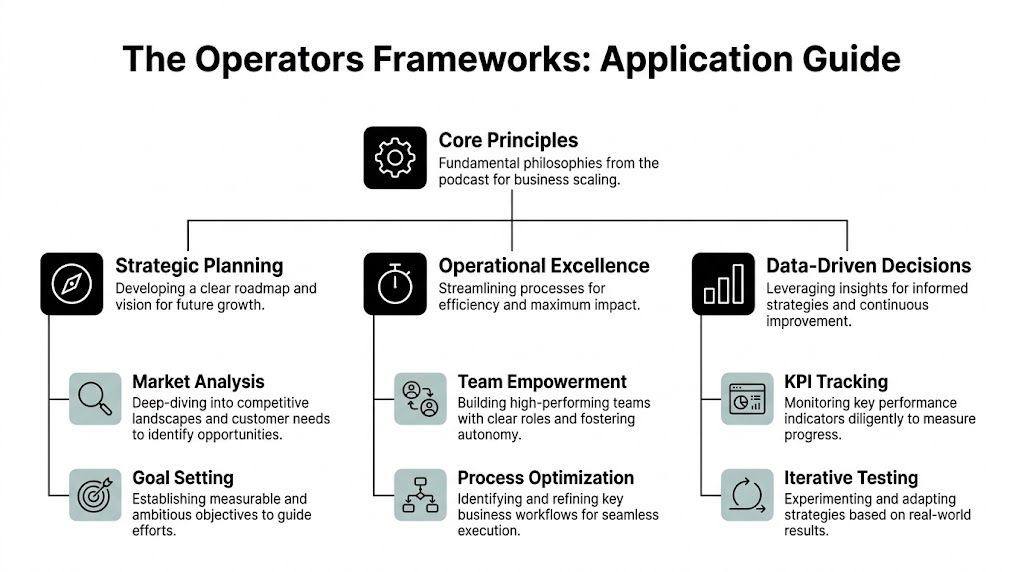
High-level operators don't just gather more data. They build systems that tell them which data deserves trust.
That usually means separating three things that smaller teams often blend together:
If all three are tangled together, teams start overreacting. They pause channels too early, over-credit retargeting, or assume creative fatigue when the actual issue sits elsewhere.
Field note: A dashboard can summarize performance. It can't decide whether the signal is real.
The operators podcast is strongest when it pushes founders to tighten process around decisions. That's where documentation and automation become practical, not bureaucratic.
If an episode changes how your team approaches reporting, campaign approvals, inventory planning, or creative testing, document that change inside a real operating system. This guide to how to create standard operating procedures is a solid companion for turning rough founder knowledge into repeatable team execution.
Then look at where the new workflow is still manual. In many brands, reporting handoffs, QA, task routing, and approval chains stay messy long after revenue scales. That's where understanding business process automation benefits becomes useful. Not as a software shopping exercise, but as a way to protect focus and reduce execution drag.
When an Operators episode lands, run it through this sequence:
Extract the principle
Example: don't trust platform-reported performance in isolation.
Map the current failure point
Maybe your paid team and finance team don't believe the same numbers.
Choose one validation method
That could be incrementality, geographic comparison, or brand tracking.
Create a process owner
Without ownership, good insights die in Slack.
Review after a fixed cycle
Keep, modify, or discard.
That's how nine-figure thinking becomes useful below nine figures. Not by copying the stack perfectly, but by upgrading the quality of the operating system around it.
One of the legitimate knocks on the operators podcast is that some of the strongest playbooks lean DTC-first. That's not a flaw. It's just reality. If you're Amazon-heavy, you have to do more translation work.
That gap matters because many 7- and 8-figure brands saw stalled growth in 2025 due to fee hikes and algorithm changes, and those platform-specific issues aren't always addressed directly in the show's broader DTC playbooks, as noted in this discussion around stalled growth and Amazon applicability.

Don't reject the show because it isn't built around FBA mechanics. Strip each lesson down to the part that transfers.
For Amazon-led brands, the useful translations usually look like this:
Creative testing lessons become listing and ad creative discipline
The principle is message-market clarity, not just social ad output.
Attribution conversations become contribution-margin discipline
You may not get the same visibility as a DTC store, but you still need a cleaner read on what paid activity actually supports profit.
Brand-building discussions become Buy Box defense and search resilience
Stronger brand demand often shows up as less fragility when marketplaces get noisy.
If your Amazon account is already complex, outside support can help pressure-test paid structure and search terms. A resource like this guide to choosing a PPC management agency for Amazon operators can be useful when you need a sharper framework for agency evaluation, not just more campaign activity.
DTC brands can often apply the show more directly, but they can also misuse it faster.
The common trap is hearing a complex media or analytics conversation and assuming your team needs a bigger stack immediately. Sometimes you do. Often you need cleaner execution first.
For DTC operators, the best use cases are:
| Situation | What to take from the podcast | What to avoid |
|---|---|---|
| Channel performance looks unstable | Use the measurement conversations to verify whether the issue is real before cutting spend | Rebuilding your entire stack because one platform underperformed |
| Creative output is inconsistent | Pull the operating logic behind how top teams structure testing and feedback loops | Chasing volume without a clear testing thesis |
| Team growth is creating drag | Apply the process discipline and clearer role ownership discussed across episodes | Adding layers of management before workflows are defined |
A useful watch if you want a direct media companion inside this topic is below.
Omnichannel brands should treat the operators podcast as a thinking tool, not a channel-specific manual.
Use DTC conversations to sharpen experimentation, then force every idea through the margin realities of Amazon and the retention realities of owned channels.
That translation step is where experienced operators separate themselves. They don't complain that advice isn't perfectly customized. They adapt it faster than competitors.
The operators podcast becomes valuable when it enters your operating cadence. Otherwise it turns into smart background audio.
A simple workflow works best. Block one listening window each week. Choose a single episode based on your current bottleneck, not based on what's newest. Then convert the listen into one page of notes with three fields: decision impact, owner, next test.
Use this rhythm:
Founder pass on Monday
Listen at a higher level. Mark anything that could change budget, channel, hiring, or reporting decisions.
Team handoff midweek
Send the relevant clip, transcript, or note to the function owner. Don't send the whole episode unless they need it.
Review on Friday
Ask one question: what changed because of this?
This approach works because it keeps the podcast tied to execution.
Bookmark segments that contain frameworks, not banter. Save the clips where hosts explain how they validate performance, structure teams, or decide whether to push or pull back. Those pieces train your leaders better than generic motivation ever will.
You can also use episodes as manager training material. A growth lead should know how to summarize the thesis of an episode and say whether it applies to your brand. If they can't, the problem isn't the podcast. The problem is weak strategic translation.
Good operator content should shorten meetings. If listening creates more confusion than clarity, you haven't assigned the right owner to process it.
Listen wherever your team already works. The podcast is available on Apple Podcasts, YouTube, and other major platforms. The key isn't platform choice. It's building a repeatable way to turn insight into action.
Maybe, but there are no public criteria beyond what's rumored around the nine-figure revenue threshold. Questions about the exact vetting process have remained unanswered publicly, according to the 9 Operators site and related community discussion. That's the honest answer.
If you're trying to get the value without access, focus on the public assets. The podcast, newsletter, clips, and transcripts already capture a meaningful share of the thinking.
No. It's more directly applicable to DTC teams, but Amazon and omnichannel brands can still get strong value from the way the hosts and guests think through testing, analytics, organizational clarity, and resource allocation. The translation work just takes more discipline.
Most ecommerce podcasts either stay too tactical or too polished. Operators is more useful because the conversations often sit closer to real operating decisions. You hear how experienced founders and executives reason, not just what they did after the fact.
Start with the episode tied to your current bottleneck. If growth quality is the issue, queue the analytics and year-in-review content. If execution is breaking under complexity, listen for team and process lessons. If the business is plateauing, go straight to the stalled-growth episodes.
If this kind of operator-level thinking is how you like to learn, Million Dollar Sellers is built for it. It's an invite-only community for serious ecommerce founders who want candid strategy sharing, vetted peers, and the kind of practical insight that helps brands scale smarter across Amazon, DTC, and omnichannel.
Join the Ecom Entrepreneur Community for Vetted 7-9 Figure Ecommerce Founders
Learn MoreYou may also like:
Learn more about our special events!
Check Events