Chilat Doina
May 14, 2026
You're probably in one of two situations right now.
Either TikTok Shop is starting to work, and a small group of creators is generating enough sales to get your attention. Or you've already tested it hard enough to know the upside is real, but the channel is turning into an operational mess. Samples go out late. Briefs are inconsistent. Creators ghost. Reporting is muddy. Finance can't reconcile payouts cleanly. Your team spends more time coordinating than learning.
That's where most brands misread the role of a tiktok shop affiliate agency. The right one isn't there to “get you more creators.” It's there to build a repeatable commercial system around creator acquisition, activation, tracking, and profit control. For a 7 to 9 figure brand, that distinction matters.
TikTok Shop is no longer a side experiment for consumer brands. The channel has become large enough that ignoring it creates a real competitive gap. By 2025, the creator network had expanded sharply, with creators earning commissions up 146% year over year, while major brands on TikTok Shop saw sales rise 97% year over year. Affiliate ecosystems also drove $5.8B in GMV in H1 2025 alone, according to TikTok Shop statistics compiled by Root Digital.
That headline growth is the easy part. The harder part is what happens after your first handful of wins.
A founder gets a few affiliates moving. One creator finds a hook that converts. Another starts posting consistently. A product gets momentum. Then the ceiling appears. The team tries to scale from a few active relationships to a real program and finds out fast that TikTok Shop affiliate management is part media, part ops, part partner management, and part financial control.
The flywheel is straightforward on paper:
In practice, every part breaks when handled manually.
A small creator roster can feel manageable. A scaled roster becomes a workflow problem before it becomes a revenue problem.
What stalls growth isn't usually a lack of creators. It's a lack of infrastructure. Brands lose speed when outreach lives in scattered spreadsheets, briefs change by account manager, commission logic isn't tiered, and no one has a clean view of which creators are producing profitable GMV.
That's why a specialized tiktok shop affiliate agency can be valuable. Not because agencies are magical. Most aren't. But the good ones solve the exact bottleneck founders hit once TikTok Shop stops being a test and starts becoming a channel.
A strong tiktok shop affiliate agency looks nothing like a generic influencer shop.
A general influencer agency optimizes for placements and brand visibility. A TikTok ads agency optimizes paid media. A TikTok Shop affiliate operator sits in a different lane. It manages creator relationships tied directly to commerce. That means the work is much less about aesthetics and much more about throughput, tracking, and unit economics.

If you're still sorting out where this function should sit inside your broader growth stack, this primer on what is an ecommerce growth agency is useful because it clarifies where channel specialists end and broader growth ownership begins.
Weak agencies sell access to a creator list.
Strong agencies build a sourcing process around fit, behavior, and commercial potential. They should know how to work inside TikTok Seller Center, sort creators by relevance, and recruit with a clear point of view on offer design. According to JoinBrands' breakdown of TikTok Shop affiliate scaling, top agencies follow a 3-phase methodology, starting with 1 to 30 creators in weeks 1 to 4, then 30 to 300 creators in months 2 to 3, and then scaling to 2,000+ creators from month 4 onward while targeting ROAS above 5:1.
That matters because it tells you what operational maturity should look like. Good agencies aren't improvising creator outreach forever. They're standardizing it.
Founders often underestimate how much performance comes down to offer structure.
An agency should help set baseline commissions, identify when to increase rates for stronger partners, and create simple tiering logic so top creators have a reason to prioritize your products. JoinBrands notes a common launch structure of 10% to 15% baseline commissions, with higher tiers for stronger performers in later stages of scale.
If an agency's compensation strategy is “we usually just start everyone the same,” that's a warning sign. Flat structures are easy to administer and weak at driving sustained output.
You do not need a masterpiece brief for every creator. You need a repeatable content framework.
The agency should own:
Most founders feel the pain here first.
A real agency coordinates product seeding, follow-up, creator status tracking, posting cadence, and payout logic. It also keeps communication moving when creators slow down. This sounds mundane until you've got dozens of creators waiting on samples and no clear owner inside the business.
Practical rule: If your internal team is spending more time chasing creators, shipments, and approvals than reviewing SKU-level performance, the function is already underbuilt.
You don't need an agency the second you open TikTok Shop. You need one when complexity outruns internal attention.
Good triggers include:
One more practical benchmark from the same JoinBrands framework matters here. In the systematize phase, one manager typically handles 50 to 100 creators, and in the scale phase one manager can oversee 300 to 400 when the workflows are built correctly. If your agency can't explain how manager capacity changes as the roster grows, they probably don't have a real operating model.
Most agency pitches sound the same because most agencies know founders want speed. They lead with creator volume, category familiarity, and vague language about turning scrolls into sales. That's not enough for a serious brand.
The biggest gap in this market is still basic proof. As noted in Avenue Z's review of TikTok Shop agencies, most content promoting these agencies fails to provide specific metrics like average ROAS or CAC. The same piece also notes reports of mixed experiences driven by tech snags and manual onboarding. That should change how you run diligence.
If you ask broad questions, you'll get polished answers.
You need an RFP that corners the agency into showing its operating system. Not its pitch deck. Not its creator roster. Its actual mechanics. A good framing reference is this overview of marketing model ROI for growing businesses, because it reinforces the same decision principle founders should use here. Compare operating models, not promises.
Use this page on TikTok Shop agency partners as a secondary reference point while you evaluate categories of service, but don't let any directory replace direct diligence.
Here's the checklist I'd use.
| Question Category | Essential Question | Green Flag Answer (What to look for) |
|---|---|---|
| Operating model | How do you move from first creators to a scaled roster? | They explain a phased process tied to recruiting, onboarding, reporting, and staffing capacity |
| Creator sourcing | How do you identify and prioritize creators? | They describe a repeatable selection method focused on fit, conversion potential, and ongoing scoring |
| Category experience | What have you learned in our product category? | They can discuss category-specific creator behavior, not just general TikTok language |
| Commission strategy | How do you structure commissions across creator tiers? | They use tiered logic and can explain when incentive changes are justified |
| Briefing process | What does your content briefing system look like? | They show templates, review steps, and a method for feeding performance insights back into briefs |
| Seeding and ops | Who owns sample coordination and follow-up? | There is a clear workflow, clear ownership, and a way to track creator status without manual chaos |
| Reporting | What metrics do you report weekly and monthly? | They focus on GMV, conversion quality, creator contribution, and margin-aware performance |
| Attribution | How do you separate top-performer impact from long-tail noise? | They segment creators and don't hide behind aggregate totals |
| Tech stack | What do you use beyond TikTok Seller Center? | They can explain where data lives, how payouts are managed, and how they track workflow health |
| Team structure | Who actually runs our account day to day? | You meet the operator, not just the closer, and they can explain manager capacity clearly |
| Compliance | How do you manage disclosure, approvals, and policy risk? | They have documented review steps and escalation paths |
| Exit readiness | What happens to data, relationships, and content if we part ways? | They have a clean answer on ownership, transition support, and account continuity |
You don't need named brands if confidentiality prevents it. You do need real economics.
Ask for anonymized snapshots showing:
If they can't produce even anonymized operating data, assume the program is held together with screenshots and enthusiasm.
The right question isn't “How many creators do you have?” It's “How many creators in a program like ours stayed productive long enough to matter?”
You can usually spot weak agencies in the first meeting.
If the pitch jumps straight to volume, pause. More creators don't automatically mean more profitable GMV. In many programs, a small number of creators produce most of the output. A credible agency will talk about finding winners, concentrating support, and avoiding waste.
An agency doesn't need your full board deck. It does need to understand what products can support affiliate payout, what inventory can be seeded aggressively, and where margin gets thin.
If they avoid this conversation, they're likely optimizing for topline activity.
Avenue Z's summary of the market highlights ongoing tech and onboarding friction. Good agencies know exactly where those friction points live because they deal with them every week. Bad ones act like the process is smooth and fully automated.
This is common. The salesperson sounds sharp. The operator shows up later and runs a generic process.
Insist on meeting the person who will own creator systems, reporting cadence, and escalation. If the delivery lead can't answer detailed questions about onboarding, briefs, and payout logic, you're not buying expertise. You're buying a handoff.
When you talk to a current or former client, skip generic questions like “Were they good?”
Ask:
Reference calls get useful when you ask about failure handling. Every agency has a success story. Mature ones also have a process for cleanup when pieces fail.
Most founders spend more time debating agency fees than contract structure. That's backward.
Pricing matters, but misaligned incentives, weak ownership language, and vague exit terms do more damage than an expensive retainer. The contract should protect control, speed, and recoverability.

This is especially important because, as outlined in Nonsensical's TikTok Shop affiliate guide, risk and compliance guidance is often overlooked. Founders need answers on contract pitfalls, IP risk, contingency planning, tedious onboarding, and dependence on TikTok's own vetting process.
This works when the scope is operationally heavy and you want predictable monthly cost. It can be fine for launch periods when a lot of the work is setup, recruitment, and process building.
The risk is obvious. The agency gets paid whether creator output is strong or weak.
This sounds aligned, and sometimes it is. The agency shares in upside, and your fee scales with results.
The problem is that raw GMV can hide ugly economics. If commission payouts rise, weak SKUs dominate, or too much volume comes from low-margin products, the agency can still win while the brand loses.
This is usually the cleanest structure for established brands. Use a base fee to cover core operations, then add performance compensation tied to clearly defined outcomes. The key is not just attaching a bonus to GMV. Tie it to qualified performance after agreed cost inputs are recognized.
Non-negotiable: Data generated during the relationship should remain accessible to the brand during the contract and after exit.
That includes creator performance records, outreach history, brief templates built for your account, reporting views, and any audience or SKU-level learnings generated while running your program.
Content rights need precision. “Usage rights” is too vague if you plan to reuse creator assets across your own channels.
Spell out what the brand can do with creator content, for how long, and in which channels. If the agency controls those rights indirectly through creator agreements, you need that chain of ownership documented.
A few clauses deserve extra attention:
The right contract doesn't assume everything will go well. It assumes something will go wrong and decides in advance who owns the cleanup.
The first 90 days determine whether the relationship becomes a channel or a distraction.
Founders often expect the agency to “start running” immediately. That's how weak launches happen. The agency needs inputs. The brand needs a narrower product focus than it thinks. Finance needs payout rules. Ops needs sample flow locked down. If any of that is sloppy, the roster fills with creators but the program doesn't compound.

According to JoinBrands' methodology for scaling TikTok Shop affiliates, top agencies use a 3-phase model. Phase 1 in weeks 1 to 4 recruits 1 to 30 creators with 10% to 15% commissions. Phase 2 in months 2 to 3 systematizes the program for 30 to 300 creators. Phase 3 from month 4 onward scales toward 2,000+ creators using predictive analytics while maintaining ROAS above 5:1.
Agencies work better when the brand is decisive.
You should provide:
A competent agency should come back with a launch package, not a vague kickoff deck.
That package should include:
Good agencies reduce ambiguity in the first month. Bad agencies create activity and call it momentum.
In the first month, the objective is simple. Prove that the offer, products, and creator targeting approach can produce repeatable signals. This stage is where you learn which SKUs attract creators, which brief angles create usable content, and whether your internal ops can support consistent seeding.
This is not the time to brag about outreach volume.
Months two and three are where the agency earns its keep. The roster grows. The manual gaps become visible. The agency should tighten onboarding, standardize briefs, group creators by performance, and introduce more disciplined reporting.
If reporting still feels anecdotal by the end of this period, the account is drifting.
Predictive analytics, creator scoring, and larger-scale management only make sense after the operating basics are under control. A lot of agencies talk as if they are in scale mode from day one. They aren't. They're still trying to get creators to post on time.
Use a one-page brief to keep the launch clean.
A strong brief gives creators freedom inside useful boundaries. Too rigid and the content feels staged. Too loose and the program fills with videos that don't move product.
A tiktok shop affiliate agency should not be judged by creator count, views, or how busy the Slack channel feels.
It should be judged by profitable GMV. That means your reporting has to go past platform activity and into economics. If the dashboard doesn't help you decide where to cut, where to push, and where margin is leaking, it's not a decision tool. It's theater.
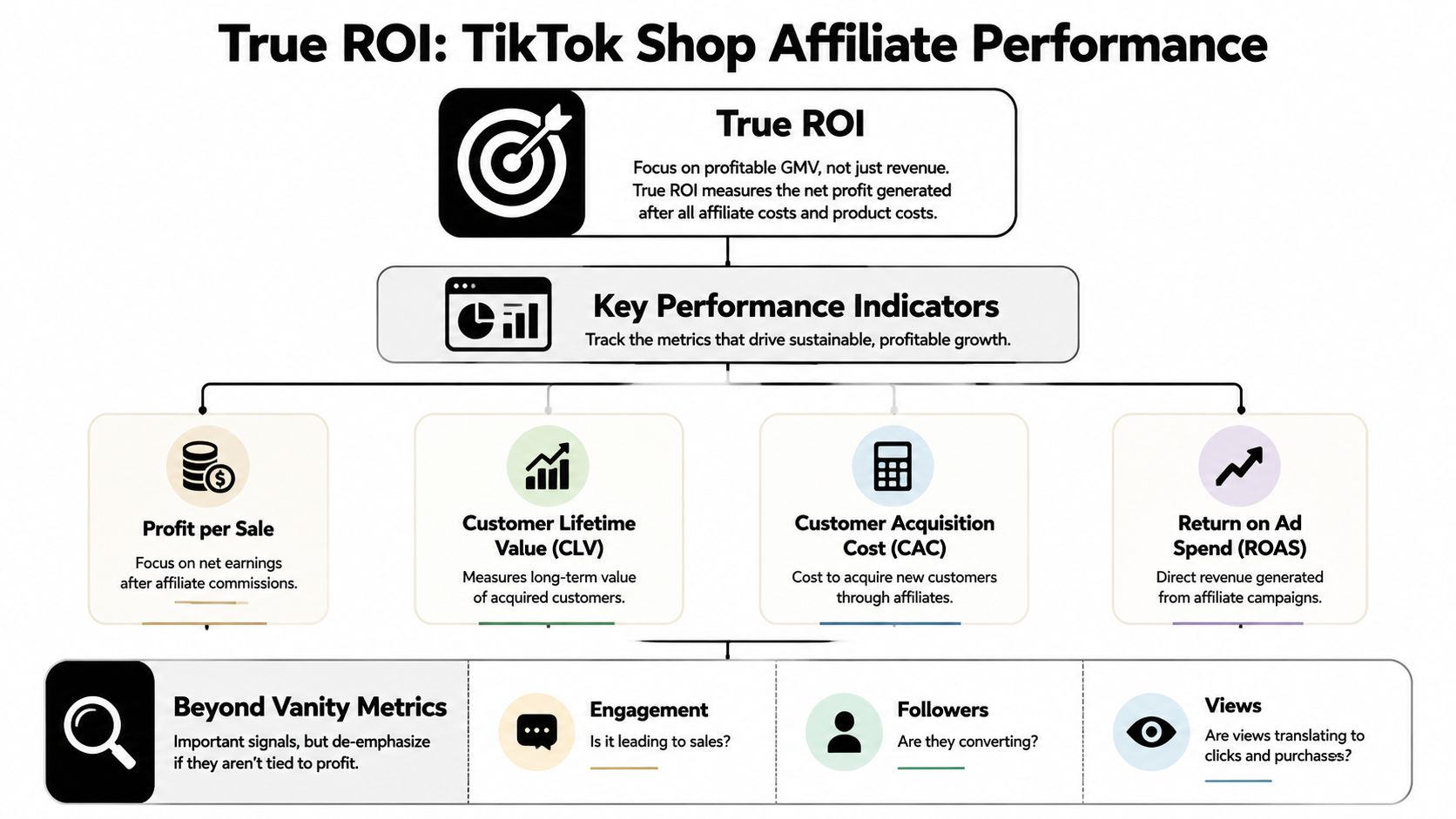
For a broader framework on measurement discipline, this guide from Raven SEO on return on marketing investment is worth reviewing. The principle applies here too. Revenue without cost context is incomplete.
A second useful reference is this breakdown of key performance indicators for ecommerce, especially if your leadership team needs shared language across DTC, marketplace, and social commerce reporting.
According to Social Snowball's ROI framework for TikTok Shop affiliate programs, effective measurement tracks KPIs including GMV, CTR of 2% to 5%, and average CVR of 4.7%. The same framework says the target for a scaled program is a blended ROAS of 5:1, and warns that 40% of agencies ignore contribution margin per SKU, which can create negative ROI even when revenue looks strong.
That last point is the one most founders should fix immediately.
A clean working formula is:
Blended ROAS = (GMV × margin - commissions - agency costs - operating overhead) / total program cost
The exact internal version can vary by finance team, but the principle shouldn't. You need to subtract the actual costs of the program before declaring victory.
If your agency reports only gross sales and a top-line payout figure, you can't tell whether the program is healthy.
Revenue is the starting point. Margin decides whether the channel deserves more capital.
Your reporting cadence should answer operational questions quickly.
The Social Snowball framework flags one of the biggest errors in the category: 40% of agencies ignore contribution margin per SKU. That's how brands end up celebrating “growth” that doesn't survive finance review.
Other recurring mistakes include:
A mature founder's question isn't “Did this creator perform?” It's “Did this creator create margin after all directly related costs?” That's the lens that separates a scalable affiliate engine from a noisy social program.
The value of a tiktok shop affiliate agency isn't just channel growth. It's how the function fits into the rest of the business.
The first question is integration. TikTok Shop should support your broader commerce system, not compete with it blindly. For some brands, that means using TikTok Shop to accelerate product discovery while Amazon captures intent-driven replenishment and DTC captures higher-LTV customer relationships. The point isn't forcing every channel to do the same job. It's assigning each one a clear role. If your team needs a broader lens on channel coordination, this guide to omnichannel retail strategy is a useful reference.
The second question is platform dependency. Founders should assume some level of volatility. That means owning your data, protecting content rights, keeping creator learnings portable, and avoiding a setup where the agency or platform controls too much of the relationship layer. If TikTok changes onboarding, approvals, or operating rules, you need the ability to adjust without rebuilding from zero.
The third question is when to bring the function in-house. The answer usually isn't ideological. It's operational. If your internal team develops strong channel knowledge, wants tighter coordination with merchandising and finance, and can run reporting, seeding, and creator management with more precision than the agency, then bringing parts of the function inside makes sense. Until then, the right agency can serve as specialized infrastructure.
A founder-level approach is simple. Treat the agency as a strategic operator, not a vendor of creator volume. Push hard on economics. Push harder on control. That's how TikTok Shop becomes durable.
If you're an established operator comparing notes on TikTok Shop, affiliate systems, channel economics, and agency selection with other serious founders, Million Dollar Sellers is where those conversations happen at the level they should.
Join the Ecom Entrepreneur Community for Vetted 7-9 Figure Ecommerce Founders
Learn MoreYou may also like:
Learn more about our special events!
Check Events